People often get confused between “inhume” and “inhumane”. Both words look similar but have very different meanings. Choosing the wrong word can make your writing confusing or unprofessional.
In this guide, we will break down the differences, explain when to use each, and show examples in everyday, academic, and professional contexts.
Understanding these two words is important because many students, writers, and professionals search online to get it right. If you have ever wondered whether it’s correct to write “inhume the body” or “inhumane treatment”, this article will give you a clear answer.
By the end, you will confidently use these words in your emails, reports, essays, or social media posts without making mistakes.
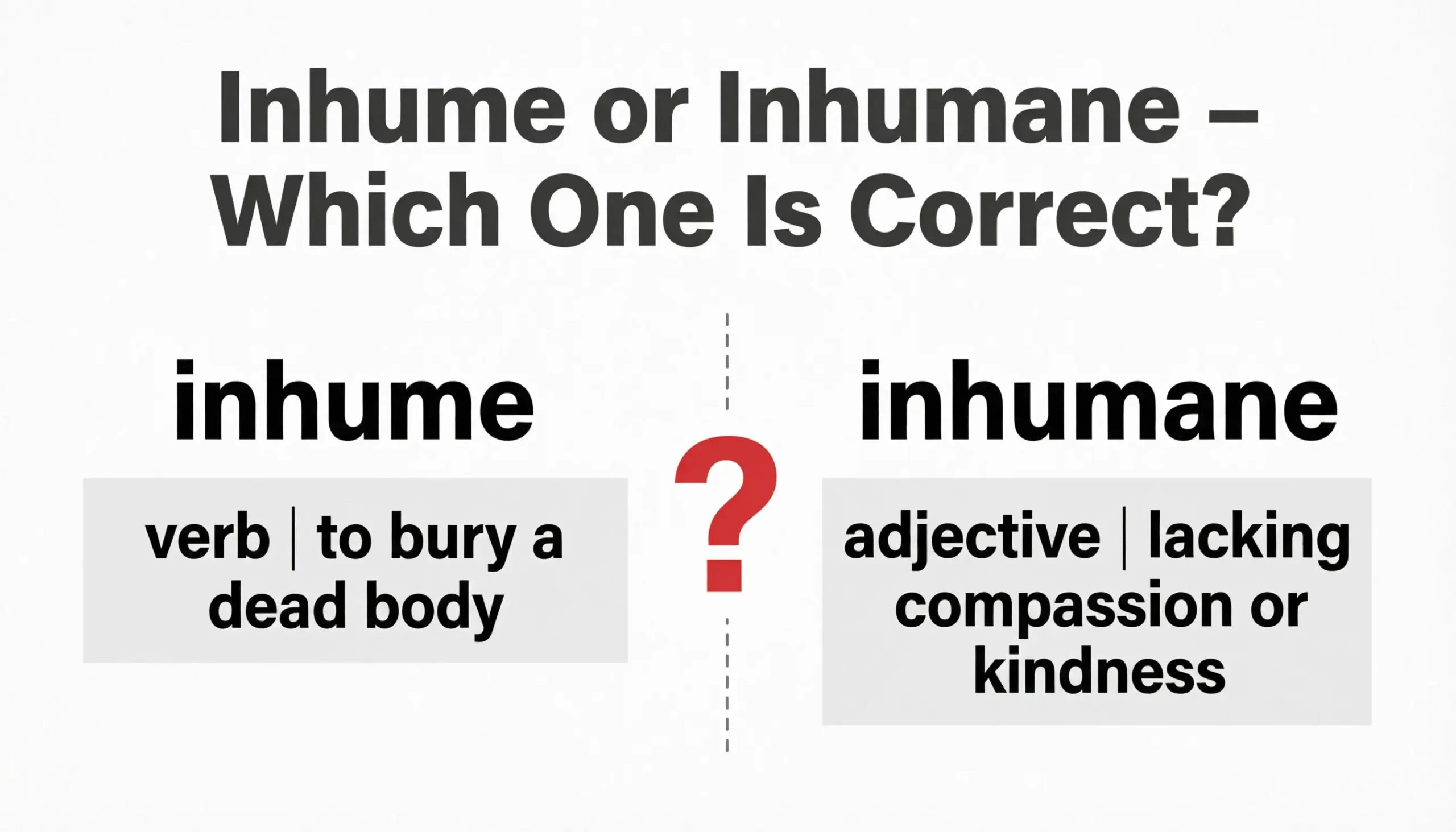
Inhume or Inhumane – Quick Answer
- Inhume → Means to bury a dead body. Example: “The villagers decided to inhume their ancestors according to tradition.”
- Inhumane → Means cruel or lacking compassion. Example: “It is inhumane to neglect the suffering of animals.”
Tip: If you are talking about burial, use inhume. If you are talking about cruelty, use inhumane.
The Origin of Inhume and Inhumane
- Inhume comes from Latin inhumare, which means “to put in the ground” (in = in, humus = ground/earth). It is an old word used mainly in formal or literary contexts.
- Inhumane combines the prefix in- (not) with humane (kind or compassionate), meaning “not humane” or cruel.
Despite similar spellings, their origins are completely different. Confusion occurs because they both start with “inh-” and appear in formal writing.
British English vs American English Spelling
Both words are spelled the same in British and American English, so no variations exist between UK and US. However, their usage may differ slightly in style guides.
| Word | Meaning | Usage Example (UK) | Usage Example (US) |
| Inhume | To bury a body | “They inhumed the body at dawn.” | “They inhumed the body at dawn.” |
| Inhumane | Cruel or lacking compassion | “The treatment of prisoners was inhumane.” | “The treatment of prisoners was inhumane.” |
Key point: Focus on context, not spelling, to avoid mistakes.
Which Spelling Should You Use?
- Use “inhume” when writing about burials, funerals, archaeology, or history. Example: academic reports on ancient civilizations may say, “The pharaoh was inhumed in a tomb.”
- Use “inhumane” when discussing ethics, behavior, animal rights, or social issues. Example: policy papers might note, “Many activists oppose inhumane practices in factory farms.”
Advice by audience:
- US: Both words are recognized; “inhumane” is more common in everyday writing.
- UK/Commonwealth: Same rules, but “inhume” may appear more often in historical or literary texts.
- Global: Always consider your reader—if discussing cruelty, use inhumane; if discussing burial, use inhume.
Common Mistakes with Inhume or Inhumane
- ❌ “The soldiers were treated inhumane.” → ✅ Correct: “The soldiers were treated inhumanely.”
- ❌ “They will inhumane the body.” → ✅ Correct: “They will inhume the body.”
- ❌ “It is inhume to neglect animals.” → ✅ Correct: “It is inhumane to neglect animals.”
- ❌ “The king was inhumane in the tomb.” → ✅ Correct: “The king was inhumed in the tomb.”
Tip: Always check whether the word is describing burial (inhume) or cruelty (inhumane).
Inhume or Inhumane in Everyday Examples
- Emails:
- Academic: “Please ensure the remains are properly inhumed.”
- HR/Corporate: “We do not tolerate inhumane treatment of employees.”
- Academic: “Please ensure the remains are properly inhumed.”
- News Articles:
- “Authorities decided to inhume the soldier with full honors.”
- “Activists condemned the inhumane conditions in the refugee camp.”
- “Authorities decided to inhume the soldier with full honors.”
- Social Media:
- “It’s inhumane to leave pets outside in the cold.”
- Rare: “Historical societies often inhume old remains in cemeteries.”
- “It’s inhumane to leave pets outside in the cold.”
- Formal Writing:
- Legal: “Subjecting prisoners to inhumane conditions violates international law.”
- Archaeology: “The remains were carefully inhumed as part of the excavation study.”
- Legal: “Subjecting prisoners to inhumane conditions violates international law.”
Inhume or Inhumane / Google Trends & Usage Data
- Inhumane is far more searched than inhume globally.
- Highest search interest: United States, UK, India (ethics, news, animal rights).
- Inhume is mostly found in historical, archaeological, or literary contexts.
- Use inhumane in blog posts or reports discussing cruelty, ethics, or human rights for better engagement.
Keyword Variations Comparison Table
| Keyword | Part of Speech | Meaning | Example Usage | Context |
| Inhume | Verb | To bury a body | “They inhumed the remains.” | Formal/Literary |
| Inhumane | Adjective | Cruel or lacking compassion | “The punishment was inhumane.” | Everyday/Academic |
| Inhumanely | Adverb | In a cruel way | “The animals were treated inhumanely.” | Social/Professional |
Exercises – Practice Using Inhume or Inhumane
- Fill in the blank:
- “It is ________ to ignore people in need.” → inhumane
- “It is ________ to ignore people in need.” → inhumane
- Choose the correct word:
- “The archaeologists decided to ________ the ancient remains.” → inhume
- “The archaeologists decided to ________ the ancient remains.” → inhume
- Rewrite correctly:
- “Leaving animals outside in winter is inhumane treatment.” → ✅ Already correct
- “Leaving animals outside in winter is inhumane treatment.” → ✅ Already correct
- Multiple choice:
- Which sentence is correct?
a) “The soldiers were inhumane in the tomb.”
b) “They inhumed the soldiers in the tomb.”
✅ Correct: b
- Which sentence is correct?
- Create your own sentence with inhume in a historical context.
Academic and Professional Writing
- Academic:
Use inhume when reporting on historical burials, anthropological studies, or forensic cases. Example: “People inhumed the skeletons according to local customs.” - Professional / Workplace:
Use inhumane to describe unethical behavior or treatment. Example: “The company strictly prohibits inhumane working conditions.” - Legal / Policy Documents:
- “Subjecting individuals to inhumane treatment violates human rights laws.”
- “The remains must be inhumed in accordance with municipal regulations.”
- “Subjecting individuals to inhumane treatment violates human rights laws.”
FAQs:
- Q: Can “inhume” be used for living people?
A: No, it only refers to burying someone who has died. - Q: Is “inhumane” ever spelled “inhumen”?
A: No, “inhumane” is the correct spelling worldwide. - Q: Can I use “inhumane” in academic writing?
A: Yes, especially in ethics, law, or social sciences. - Q: Are “inhume” and “inhumane” pronounced differently?
A: Yes. “Inhume” sounds like /ɪnˈhjuːm/, while “inhumane” sounds like /ˌɪn.hjuːˈmeɪn/. - Q: Which word is more common online?
A: People search for and use ‘inhumane’ much more frequently.” - Q: Can “inhumane” be used in emails?
A: Yes, to highlight unfair or cruel practices professionally. - Q: Is “inhume” outdated?
A: Somewhat; it appears mostly in literary, historical, or formal contexts. - Q: What is the opposite of “inhumane”?
A: “Humane” – showing compassion or kindness. - Q: Can “inhume” be used metaphorically?
A: Rarely, it is almost always literal (burying).
Conclusion:
Understanding the difference between inhume and inhumane is essential for accurate writing. Remember:
- Inhume → bury a dead body, mainly formal or literary.
- Inhumane → cruel or lacking compassion, common in social, professional, or academic writing.
Avoid common mistakes by checking the context before writing. For global audiences, inhumane will be more familiar, while inhume suits historical, archaeological, or formal documents. Practicing exercises and seeing examples in emails, news, and academic papers will help you master correct usage.
When in doubt, ask yourself: Am I talking about burial or cruelty? This simple test ensures your writing stays professional, clear, and precise.

I hold a degree in English Literature and Linguistics and have worked extensively on educational blogs, comparison websites, and digital learning platforms. My writing focuses on simplifying complex language rules, highlighting British vs American English differences, and providing practical examples for everyday usage.