English is full of words that sound the same but mean very different things. These words are called homophones, and they often confuse learners, writers, and even native speakers. One of the most searched and misunderstood pairs is herd or heard.
People often type this keyword into Google because both words sound identical when spoken, yet their meanings, spellings, and uses are completely different. This confusion shows up in emails, social media posts, school essays, and even professional writing.
If you have ever paused while writing a sentence like “I herd the news” or “I heard of cows,” you are not alone. Choosing the wrong word can change the meaning of your sentence or make it look careless.
This article solves that problem. It gives you a quick answer, a deep explanation, real-life examples, and clear advice on when to use herd and when to use heard. By the end, you will understand the difference with confidence and never mix them up again.
Herd or Heard – Quick Answer
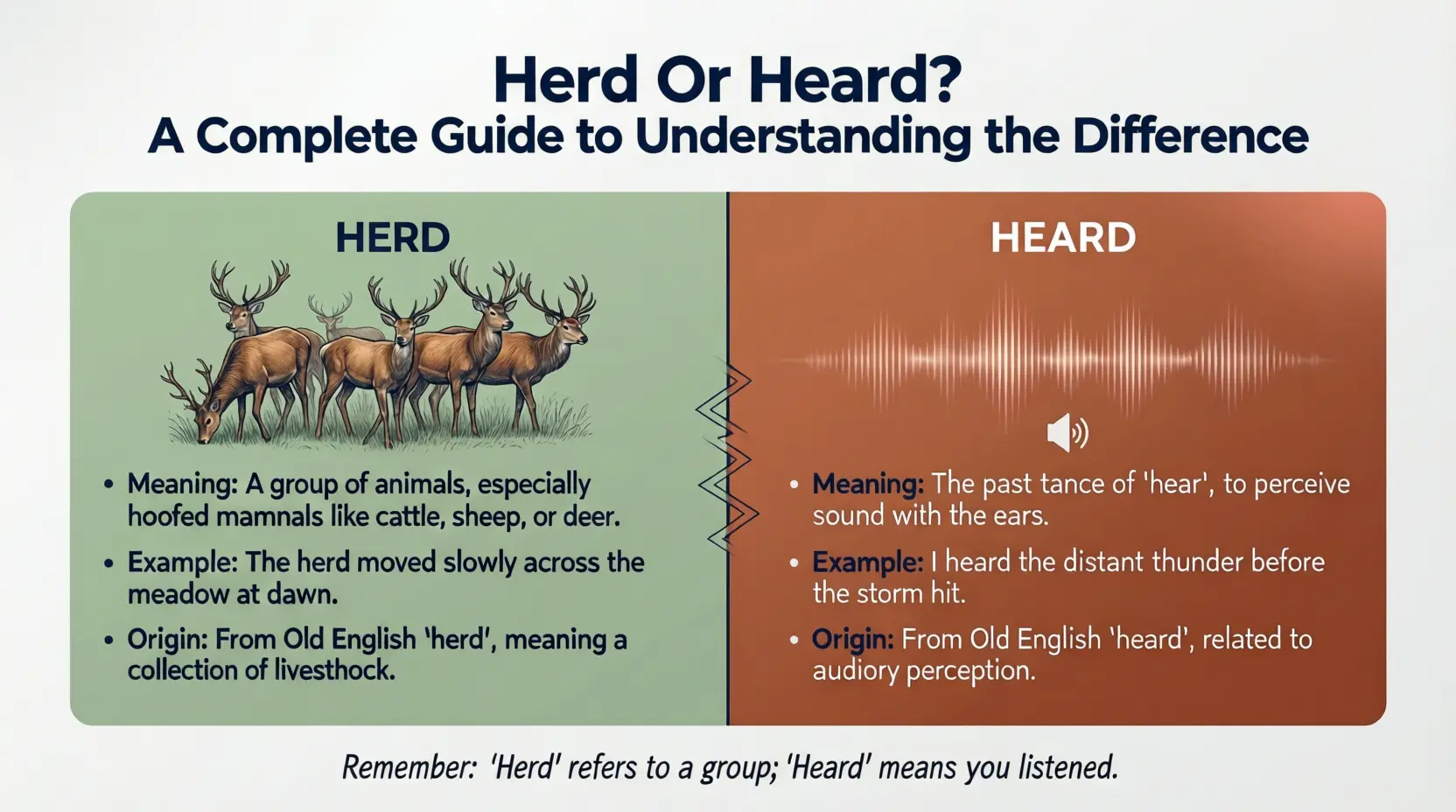
Herd is a noun or verb related to animals or groups moving together.
Heard is the past tense of the verb “hear,” which means to listen or receive sound.
Simple examples
- Herd: The farmer moved the herd of sheep.
- Heard: I heard a loud noise last night.
Easy rule to remember
- If it is about animals or groups, use herd.
- If it is about sound or listening, use heard.
The Origin of Herd or Heard
Understanding where words come from makes them easier to remember.
Origin of Herd
The word herd comes from Old English “heord,” which meant a group of animals kept together. It has Germanic roots and is related to words in Old High German and Old Norse that describe flocks or groups. Over time, herd kept its strong connection to animals such as cows, sheep, deer, and goats.
Later, English speakers began using herd in a broader sense to describe groups of people acting together, often without thinking deeply. This led to phrases like “herd mentality.”
Origin of Heard
Heard comes from the Old English verb “hīeran,” meaning to listen or perceive sound. It is the past tense and past participle of hear. Unlike herd, heard has always been connected to sound, listening, or receiving information.
Why spelling differences exist
Even though herd and heard sound the same, they evolved from different roots. English spelling kept their original forms, which is why we have two different spellings for the same sound. This is common in English and is the main reason people get confused.
British English vs American English Spelling
Good news: there is no spelling difference between British English and American English for herd or heard. Both varieties use the same spellings and meanings.
However, usage style and examples may differ slightly in context.
Comparison Table: British vs American English
| Aspect | British English | American English |
| Herd spelling | Herd | Herd |
| Heard spelling | Heard | Heard |
| Meaning of herd | Group of animals or people | Group of animals or people |
| Meaning of heard | Past tense of hear | Past tense of hear |
| Example | I heard the news on the radio. | I heard the news on TV. |
👉 Key point: You do not need to change spelling based on region. Just choose the correct word.
Which Spelling Should You Use?
The choice between herd and heard depends on meaning, not location.
Use herd if:
- You are talking about animals.
- You are describing a group moving together.
- You are using phrases like herd mentality.
Examples:
- A herd of elephants crossed the road.
- People followed the trend like a herd.
Use heard if:
- You mean listening or receiving sound.
- You are talking about news, rumors, or information.
Examples:
- I heard your voice clearly.
- She heard about the job opening.
Audience-based advice
- US audience: Same rules apply.
- UK/Commonwealth audience: Same rules apply.
- Global audience: Focus on meaning, not accent or region.
Common Mistakes with Herd or Heard
Even simple words cause frequent errors.
Mistake 1: Using herd instead of heard
❌ I herd a strange sound.
✅ I heard a strange sound.
Mistake 2: Using heard instead of herd
❌ A heard of cows ran away.
✅ A herd of cows ran away.
Mistake 3: Confusion in fast typing
People often type the wrong word because spellcheck does not catch homophones.
How to avoid mistakes
- Pause and ask: Is this about sound or animals?
- Replace the word mentally:
- Sound = heard
- Group = herd
Herd or Heard in Everyday Examples
In emails
- Correct: I heard your concern and will reply soon.
- Correct: The farmer sold his herd last year.
In news
- Witnesses heard a loud explosion.
- A herd of deer blocked the highway.
On social media
- I just heard the best news ever!
- Stop following the herd and think for yourself.
In formal writing
- The jury heard all the evidence.
- The study observed a herd of cattle over six months.
Herd or Heard – Google Trends & Usage Data
Search data shows that “herd or heard” is commonly searched by:
- Students learning English
- Content writers
- Non-native speakers
- People checking spelling before posting online
Popular regions
- United States
- United Kingdom
- India
- Pakistan
- Canada
- Australia
Context of searches
- Grammar checks
- Homework help
- Blog writing
- Professional emails
Heard is used more often overall because it appears in daily speech.
Herd is less frequent and mostly appears in agriculture, biology, and metaphorical writing.
Comparison Table: Herd vs Heard
| Feature | Herd | Heard |
| Part of speech | Noun / Verb | Verb (past tense) |
| Meaning | Group of animals or people | Past tense of hear |
| Related to sound? | No | Yes |
| Related to animals? | Yes | No |
| Example | A herd of sheep | I heard a noise |
| Common error | Used instead of heard | Used instead of herd |
FAQs:
1. Are herd and heard pronounced the same?
Yes. They are homophones and sound exactly the same.
2. Is “herd” ever used for people?
Yes. Example: herd mentality.
3. Is “heard” always past tense?
Yes. It is the past tense and past participle of hear.
4. Can spellcheck catch herd or heard mistakes?
Usually no, because both are correct words.
5. Which one is more common in daily English?
Heard is more common than herd.
6. Do British and American English use them differently?
No. Both use them the same way.
7. How can I remember the difference easily?
Remember: animals = herd, ears = heard.
Conclusion:
The confusion between herd or heard is common, but it is also easy to fix once you understand the core difference. Herd relates to animals or groups moving together, while heard relates to listening and sound. They sound the same, but their meanings live in very different worlds. English spelling preserves this difference because both words come from different historical roots.
If you are writing an email, a blog post, a social media caption, or a formal document, choosing the right word improves clarity and professionalism. The key is to slow down and check meaning, not sound.
With the examples, tables, and tips in this guide, you now have a complete and simple understanding of herd or heard. Use this knowledge with confidence, and you will never make this mistake again.

I am an Emily Carter Brooks U.S.A based linguistics writer known for my clear, reader-friendly explanations of English grammar and vocabulary differences. I have contributed to multiple online language resources and specializes in spelling variations, pronunciation confusion, and British vs American English comparisons. I believes that learning English should be practical, engaging, and stress-free.