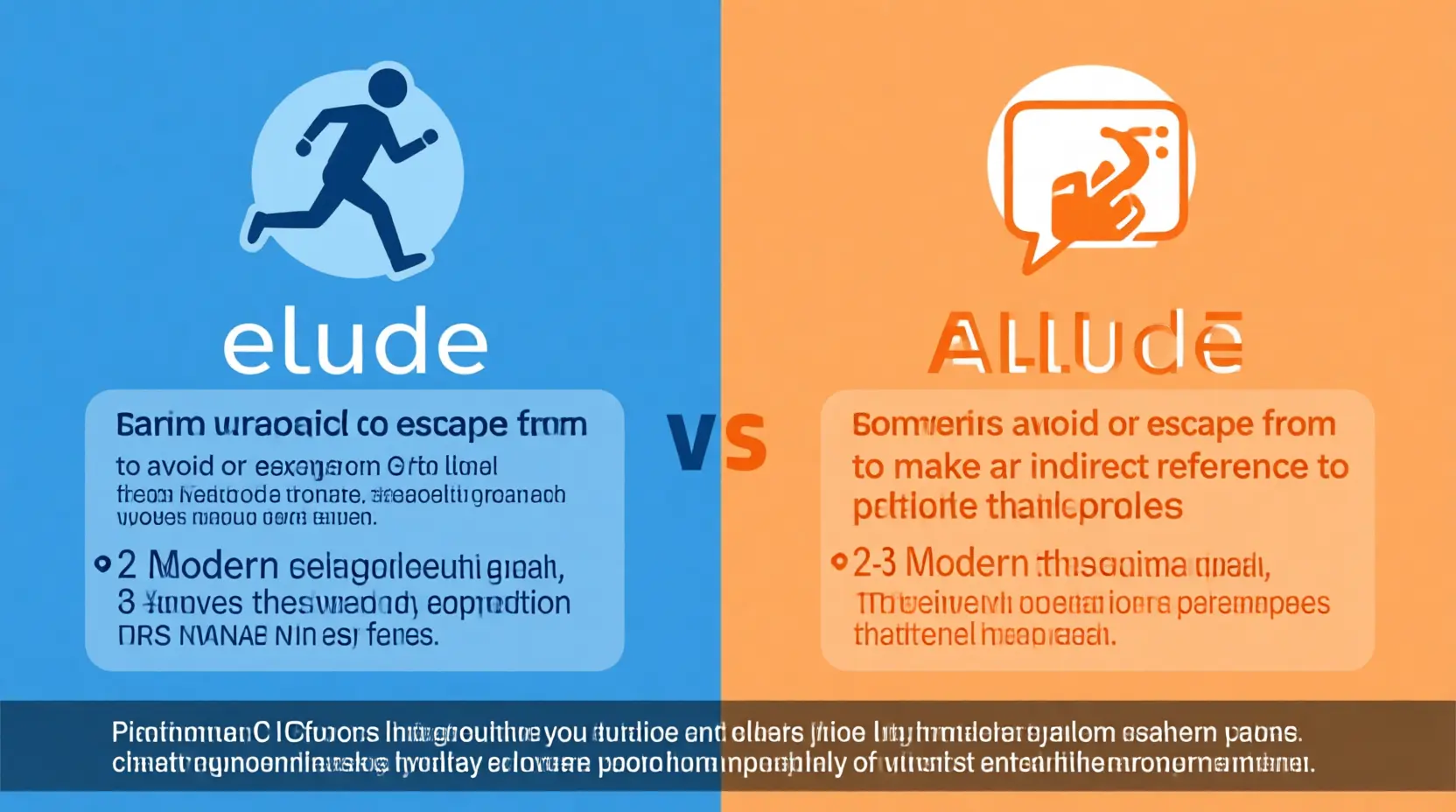
English learners and even native speakers often search for “elude or allude” because these two words sound similar but mean very different things. One small mistake can change the whole meaning of a sentence. That is why this keyword is popular among students, writers, bloggers, and professionals.
Many people confuse elude and allude in exams, emails, articles, and even news writing. Both words come from Latin, both are verbs, and both are used in formal English. But their meanings are not the same at all. One talks about escape, and the other talks about reference.
This confusion happens because English has many words that look or sound alike but serve different purposes. When people write quickly, they often choose the wrong word without realizing it. Over time, these mistakes spread online, making the confusion worse.
This article solves that problem clearly and simply. You will get a quick answer, real-life examples, grammar tips, comparison tables, usage advice for American and British English, and practice exercises. By the end, you will confidently know when to use elude and when to use allude, whether you are writing for school, work, or the web.
Elude or Allude – Quick Answer
Elude means to escape, avoid, or not be caught or understood.
Allude means to mention something indirectly or hint at it.
Examples:
- The thief eluded the police.
- She alluded to her past without giving details.
👉 Elude = escape
👉 Allude = indirect mention
The Origin of Elude and Allude
Both words come from Latin, which explains why they sound similar.
Elude
- From Latin eludere
- Meaning: to escape, mock, or slip away
- Entered English in the 1500s
Allude
- From Latin alludere
- Meaning: to play with, refer to indirectly
- Also entered English in the 1500s
The spelling difference exists because the Latin prefixes are different:
- e- (out of) → elude
- ad- (toward) → allude
Even though they look alike, their meanings moved in different directions over time.
British English vs American English Spelling
Good news: there is NO spelling difference between British and American English for these words.
| Word | British English | American English |
| Elude | Elude | Elude |
| Allude | Allude | Allude |
✅ Same spelling
✅ Same meaning
✅ Same usage rules
The confusion is about meaning, not spelling.
Which Spelling Should You Use?
Since both spellings are the same worldwide, your choice depends on meaning, not location.
Use elude if:
- Something escapes
- Something cannot be caught
- Something is hard to understand
Use allude if:
- You hint at something
- You mention something indirectly
- You do not explain fully
Audience advice:
- US audience → Follow meaning rules
- UK/Commonwealth → Same rules
- Global audience → Use simple examples for clarity
Common Mistakes with Elude or Allude
❌ Wrong:
- He alluded the police.
✅ Correct: - He eluded the police.
❌ Wrong:
- She eluded to the problem.
✅ Correct: - She alluded to the problem.
Easy memory trick:
- Elude = Escape
- Allude = Hint
If your sentence involves running away, use elude.
If your sentence involves suggesting, use allude.
Elude or Allude in Everyday Examples
Emails
- The reason for the delay eluded me.
- He alluded to a future meeting.
News
- The suspect eluded capture for weeks.
- The minister alluded to policy changes.
Social Media
- This joke alludes to an old movie.
- The meaning eludes many readers.
Formal Writing
- The theory eludes simple explanation.
- The author alludes to earlier research.
Elude or Allude – Google Trends & Usage Data
Search data shows that:
- “elude or allude” is most searched by:
- Students
- ESL learners
- Writers and bloggers
- Students
Usage trends:
- Elude is common in:
- Crime news
- Academic writing
- Psychology texts
- Crime news
- Allude is common in:
- Literature
- Essays
- Speeches
- Literature
Countries with high search interest:
- United States
- United Kingdom
- India
- Pakistan
- Canada
This shows global confusion and strong learning intent.
Elude vs Allude – Comparison Table
| Feature | Elude | Allude |
| Meaning | Escape or avoid | Hint or refer indirectly |
| Action type | Physical or mental | Communication-based |
| Common contexts | Crime, ideas, understanding | Writing, speech, literature |
| Needs object? | Yes | Usually “to” something |
| Example | Elude capture | Allude to a story |
Elude or Allude in Academic Writing
In academic writing, word choice must be precise.
Elude in academics:
- “The solution eludes current models.”
- “The concept eludes simple definition.”
Allude in academics:
- “The paper alludes to earlier studies.”
- “The author alludes to social theory.”
📌 Tip:
Use elude for difficulty.
Use allude for reference.
Elude or Allude in Professional Writing
In business and professional settings, mistakes reduce clarity.
Correct professional use:
- “The cause of the error eluded the team.”
- “She alluded to a promotion plan.”
Avoid vague writing:
- Do not mix these words.
- Keep sentences short.
- Choose clarity over complexity.
Practice Exercises: Elude or Allude
Exercise 1: Choose the correct word
- The answer _______ me.
- He _______ to a secret deal.
Answers:
- eluded
- alluded
Exercise 2: Fill in the blank
- The criminal _______ arrest.
- The speaker _______ to history.
Exercise 3: Rewrite correctly
❌ She eluded to the issue.
✅ She alluded to the issue.
Practicing these helps fix the confusion forever.
FAQs:
1. Is “elude or allude” a spelling issue?
No, it is a meaning issue, not spelling.
2. Can elude be used for ideas?
Yes. Ideas, answers, and meanings can elude someone.
3. Does allude always need “to”?
Usually yes: allude to something.
4. Are these words formal?
Yes, both are formal and professional.
5. Which is more common?
Elude appears more in news.
Allude appears more in writing and speeches.
6. Can I use them in exams?
Yes, but only if used correctly.
7. Do British and American English differ?
No difference at all.
Conclusion:
Understanding the difference between elude or allude is essential for clear and confident English. Even though these words sound similar, their meanings are completely different. One talks about escape and difficulty, while the other talks about hinting and indirect reference.
If something runs away from you, avoids capture, or is hard to understand, the correct word is elude. If you are pointing to an idea without naming it directly, the correct word is allude. Remembering this simple rule can prevent many writing mistakes.
This confusion appears often in student essays, professional emails, and online content. Using correct words also builds trust with readers and makes your writing sound polished and professional.
With the examples, tables, exercises, and usage tips in this guide, you now have everything you need. If you are writing for school, work, or the internet, you can confidently choose the right word every time.

I hold a degree in English Literature and Linguistics and have worked extensively on educational blogs, comparison websites, and digital learning platforms. My writing focuses on simplifying complex language rules, highlighting British vs American English differences, and providing practical examples for everyday usage.