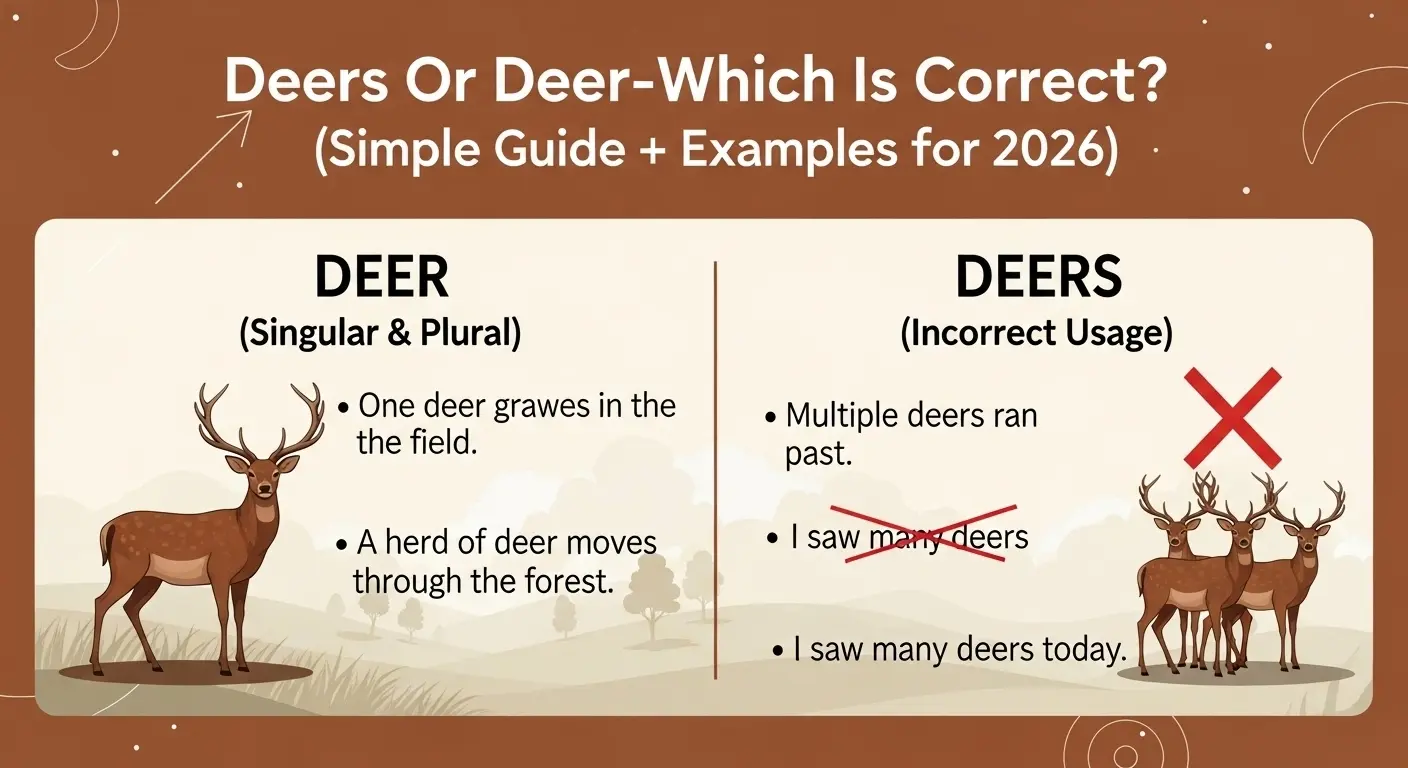
You are writing a sentence and suddenly pause: is it “deers” or “deer”? This small doubt confuses many English learners and even native speakers. It looks simple, but the rule behind it is not what you expect. Most nouns in English change in plural form by adding “-s” or “-es.” So naturally, people assume “deers” must be correct. But in reality, English has many exceptions and this is one of them.
People search for “deers or deer” because they want a quick answer, but also a clear explanation. They want to know when to use each form and why the rule is different. This confusion often appears in writing, exams, emails, and even professional content.
In this guide, you will learn the correct form, the reason behind it, and how to use it in real life. We will also cover common mistakes, examples, and usage trends.
By the end, you will never confuse “deers” and “deer” again.
Deers or Deer – Quick Answer
The correct word is “deer.”
- “Deer” is both singular and plural.
- “Deers” is incorrect in standard English.
Examples:
- ✅ I saw a deer in the forest. (singular)
- ✅ I saw many deer in the forest. (plural)
- ❌ I saw many deers in the forest.
So, if you talk about one or many, the word stays the same: deer.
The Origin of Deers or Deer
The word “deer” comes from Old English “dēor.” In early English, this word did not mean a specific animal. It meant any wild animal.
Over time, the meaning changed and became more specific. Today, “deer” refers to animals like stags, bucks, and does.
Now, here is the key point:
In Old English, some animal names did not change in plural form. These are called irregular plurals.
Other examples include:
- sheep → sheep
- fish → fish
- species → species
So, “deer” follows this old rule. That is why we do not add “-s.”
The form “deers” sometimes appears in old texts or rare dialects, but it is not correct in modern English.
British English vs American English Spelling
Good news: there is no difference between British and American English for this word.
Both follow the same rule:
- Singular = deer
- Plural = deer
Comparison Table
| Form | British English | American English | Correct? |
| Deer | ✔ Yes | ✔ Yes | ✔ Correct |
| Deers | ❌ No | ❌ No | ❌ Incorrect |
Unlike words like “color/colour” or “organize/organise,” this word stays the same in both systems.
Which Spelling Should You Use?
You should always use “deer” no matter your audience.
For different audiences:
- US audience: Use “deer”
- UK audience: Use “deer”
- Global audience: Use “deer”
There is no situation in modern English where “deers” is the right choice.
Simple advice:
If you are writing anything blog, email, school paper, or social media stick with “deer.”
Common Mistakes with Deers or Deer
Many learners make small but common mistakes. Here are the most frequent ones:
1. Adding “-s” for plural
- ❌ Many deers are running
- ✅ Many deer are running
2. Thinking it follows normal plural rules
- ❌ One deer, two deers
- ✅ One deer, two deer
3. Mixing with similar animals
- ❌ Sheeps and deers are animals
- ✅ Sheep and deer are animals
4. Overcorrecting in writing
Some people avoid using plural because they are unsure.
- ❌ I saw animal (to avoid mistake)
- ✅ I saw deer
Quick Tip:
If the animal is “deer,” never add “-s.”
Deers or Deer in Everyday Examples
Let’s see how “deer” is used in real-life situations.
1. In Emails
- “We spotted three deer near the campsite yesterday.”
2. In News
- “A group of deer crossed the highway early morning.”
3. On Social Media
- “Just saw two beautiful deer in the park 🦌”
4. In Formal Writing
- “The forest is home to many species of deer.”
5. In Conversation
- “Did you see those deer near the road?”
In all cases, the word stays the same.
Deers or Deer – Google Trends & Usage Data
Search data shows that many people type “deers” online. This is because they follow the normal plural rule.
Usage Trends:
- “Deer” is the correct and widely used form worldwide
- “Deers” appears in searches, but mostly as a mistake
Popular Regions:
- High searches in:
- United States
- United Kingdom
- India
- Pakistan
Context of Searches:
People search:
- “Is deers correct?”
- “Plural of deer”
- “Deers or deer difference”
This shows that the confusion is global.
Comparison Table: Deers vs Deer
| Feature | Deer | Deers |
| Meaning | Animal (correct form) | Same meaning (wrong form) |
| Usage | Singular & plural | Not used in modern English |
| Grammar | Irregular noun | Incorrect plural |
| Example | Many deer are here | Many deers are here ❌ |
| Acceptability | ✔ Standard English | ❌ Incorrect |
FAQs:
1. Is “deers” ever correct?
No, “deers” is not correct in modern English.
2. What is the plural of deer?
The plural of deer is deer.
3. Why doesn’t deer change in plural?
Because it is an irregular noun from Old English.
4. Are there other words like deer?
Yes, such as:
- sheep
- fish
- species
5. Can I use “deers” in informal writing?
No. Even in casual writing, it is considered wrong.
6. How can I remember this rule?
Think: “One deer, many deer.”
7. Is “deer” used for all types?
Yes, it covers all types like:
- red deer
- white-tailed deer
8. Do native speakers ever say “deers”?
Rarely, and usually by mistake.
9. Is this rule important for exams?
Yes, using “deers” can be marked as a grammar error.
Conclusion:
The confusion between “deers” and “deer” is very common, but the rule is simple once you understand it. The correct form is always “deer,” whether you are talking about one or many. Unlike most English nouns, this word does not change in plural form. This comes from its Old English origin, where some animal names stayed the same in both singular and plural.
There is also no difference between British and American English here, which makes it easier to remember. No matter where you are writing or who your audience is, “deer” is always the right choice. Using “deers” can make your writing look incorrect and unprofessional.
To avoid mistakes, focus on practice and real-life examples. Read sentences, write your own, and remember the simple rule: one deer, many deer. This small detail can improve your grammar and make your writing clearer.
Now that you understand the difference, you can use “deer” with confidence in any situation.

I am an Emily Carter Brooks U.S.A based linguistics writer known for my clear, reader-friendly explanations of English grammar and vocabulary differences. I have contributed to multiple online language resources and specializes in spelling variations, pronunciation confusion, and British vs American English comparisons. I’m passionate about helping learners improve their English through practical, everyday communication. engaging, and stress-free.