Many people search for “concurrent or consecutive” because these two words look serious, sound similar, and are often used in schools, offices, courts, and official documents. But their meanings are very different. Using the wrong one can change the meaning of a sentence completely.
For example, imagine a student taking two courses at the same time. That is concurrent learning. But if the student takes one course after finishing the other, that is consecutive learning. Small word change, big meaning change.
People often feel confused because both words talk about time, order, and events. They are also common in academic writing, legal language, project planning, and job descriptions. Many non-native English speakers struggle with them, and even native speakers sometimes mix them up.
This article solves that confusion once and for all. You will get a quick answer, clear examples, real-life usage, common mistakes, and professional advice on when to use each word. By the end, you will confidently know whether concurrent or consecutive is the right choice for your sentence.
Concurrent or Consecutive – Quick Answer
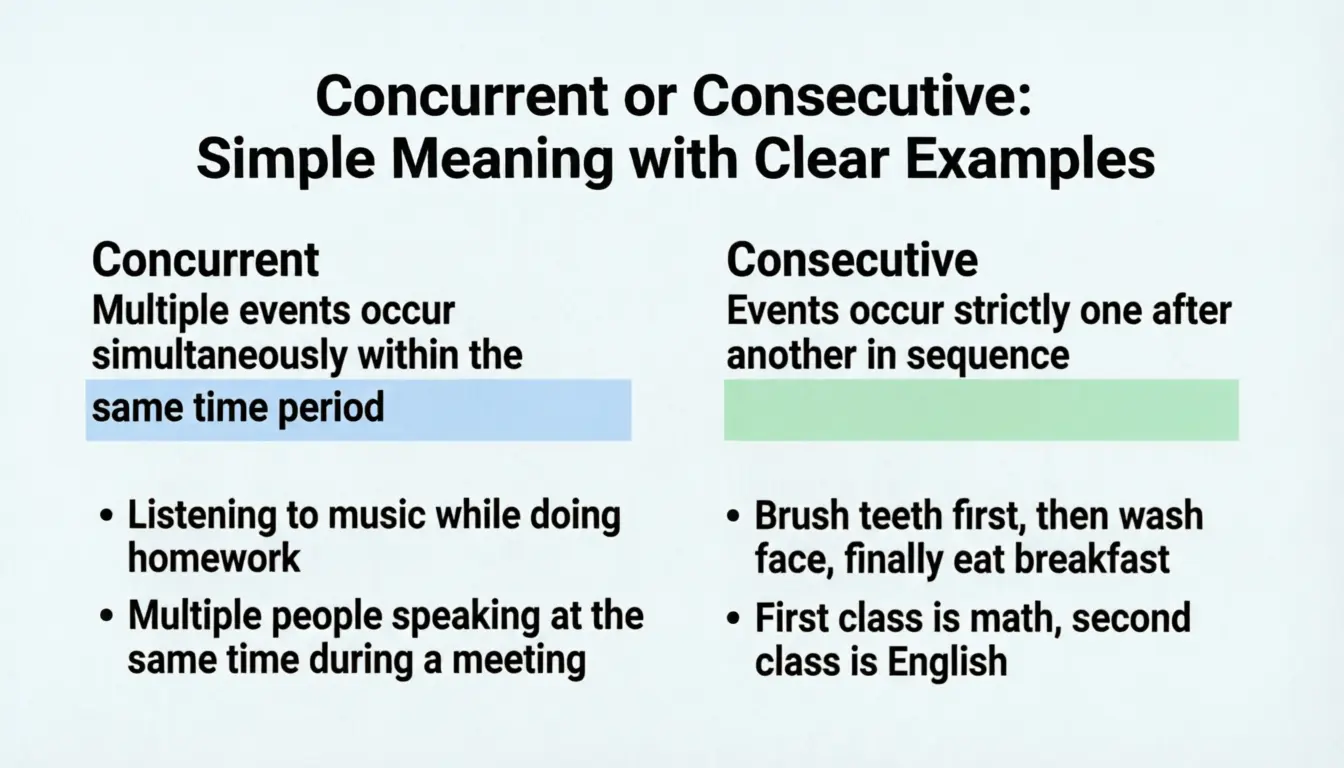
Concurrent means happening at the same time.
Consecutive means happening one after another.
Simple Examples
- The meetings run concurrently. (At the same time)
- The meetings run consecutively. (One after the other)
More Examples
- She studied two degrees concurrently.
- He worked night shifts for five consecutive days.
👉 Rule to remember:
- Same time = Concurrent
- One by one = Consecutive
The Origin of Concurrent and Consecutive
Origin of Concurrent
The word concurrent comes from the Latin word concurrere, which means “to run together.”
This explains its meaning clearly: things that happen together in time.
It entered English in the 1600s and was mostly used in formal and academic contexts.
Origin of Consecutive
The word consecutive comes from the Latin word consecutivus, meaning “following closely.”
This shows why it means one event follows another.
Why Confusion Exists
- Both words are formal
- Both describe time
- Both are common in education and law
But their roots show a clear difference:
together vs following
British English vs American English Spelling
Good news! 🎉
There is no spelling difference between British and American English for these words.
Comparison Table
| Word | British English | American English | Meaning |
| Concurrent | Concurrent | Concurrent | Same time |
| Consecutive | Consecutive | Consecutive | One after another |
✔ Same spelling
✔ Same meaning
✔ Same usage
Which One Should You Use?
Choose based on time and order.
Use Concurrent When:
- Events happen at the same time
- Tasks overlap
- Courses or jobs run together
Example:
- She holds two jobs concurrently.
Use Consecutive When:
- Events happen in order
- There is no overlap
- One thing finishes before the next starts
- He won three consecutive awards.
Audience-Based Advice
- US audience: Use simple examples
- UK/Commonwealth: Same rules apply
- Global audience: Add examples for clarity
Common Mistakes with Concurrent or Consecutive
Mistake 1: Using them as synonyms
❌ The classes are consecutive at the same time.
✅ The classes are concurrent.
Mistake 2: Confusing time order
❌ She worked two jobs consecutively (if same time)
✅ She worked two jobs concurrently
Mistake 3: Overusing in casual writing
In daily chat, simpler words may work better:
- Instead of concurrent, say at the same time
- Instead of consecutive, say one after another
Concurrent or Consecutive in Everyday Examples
Emails
- “These tasks will run concurrently to save time.”
- “Please complete the steps consecutively.”
News
- “The court ordered concurrent sentences.”
- “The team won five consecutive matches.”
Social Media
- “Watching two shows concurrently 😂”
- “Gym for 10 consecutive days!”
Formal Writing
- “The experiments were conducted concurrently.”
- “The trials occurred on consecutive days.”
Concurrent or Consecutive – Google Trends & Usage Data
Search data shows:
- Concurrent is popular in:
- Education
- Law
- Project management
- Education
- Consecutive is popular in:
- Sports
- News
- Daily achievements
- Sports
Country Usage
- USA: Heavy use in legal and academic writing
- UK: Common in education and reports
- Global: Often searched together due to confusion
👉 Most users search this keyword to understand the difference, not spelling.
Comparison Table: Concurrent vs Consecutive
| Feature | Concurrent | Consecutive |
| Time | Same time | One after another |
| Overlap | Yes | No |
| Common Fields | Law, education | Sports, schedules |
| Example | Two jobs at once | Five days in a row |
Concurrent or Consecutive in Academic Writing
In academic writing, accuracy matters a lot.
Correct Academic Usage
- “The courses were taken concurrently.”
- “The tests were conducted on consecutive days.”
Why It Matters
Using the wrong word can:
- Change meaning
- Confuse readers
- Lower writing quality
Tip
If events overlap → Concurrent
If events follow → Consecutive
Concurrent or Consecutive in Professional Writing
In professional settings, clarity is key.
Business Examples
- “The teams will work concurrently on the project.”
- “Meetings are scheduled on consecutive days.”
Legal Examples
- “The judge gave concurrent sentences.”
- “The penalties apply to consecutive violations.”
Using the correct word builds trust and professionalism.
Exercises: Practice Concurrent or Consecutive
Exercise 1: Choose the Correct Word
- He worked 10 days __________ without a break.
- She studied two majors __________.
Answers:
- Consecutive
- Concurrently
Exercise 2: Fix the Sentence
❌ The events happened consecutively at the same time.
✅ The events happened concurrently.
FAQs:
1. Are concurrent and consecutive opposites?
Yes. One means same time, the other means one after another.
2. Can events be both concurrent and consecutive?
No. They describe different time patterns.
3. Is concurrently an adverb?
Yes. Example: “They worked concurrently.”
4. Is consecutive always about numbers or days?
Mostly yes, but it can also describe actions or events.
5. Which word is more formal?
Both are formal, but concurrent sounds more technical.
6. Can I use them in casual writing?
Yes, but simpler words are often better.
7. Are these words common in exams?
Yes, especially in academic English tests.
Conclusion:
The difference between concurrent and consecutive is simple but very important. Concurrent means things happen at the same time. Consecutive means things happen one after another. Mixing them up can change the meaning of your sentence and confuse your reader.
These words are common in academic writing, professional documents, legal texts, and everyday communication. Knowing how to use them correctly makes your English clearer and more confident. When writing for school, work, or online, always think about time and order.
If events overlap, choose concurrent. If events follow in sequence, choose consecutive. This one rule will help you avoid mistakes every time.
Mastering small word differences like this improves not only your grammar but also your credibility as a writer. Keep practicing, check examples, and soon these words will feel natural to you.

I am an Emily Carter Brooks U.S.A based linguistics writer known for my clear, reader-friendly explanations of English grammar and vocabulary differences. I have contributed to multiple online language resources and specializes in spelling variations, pronunciation confusion, and British vs American English comparisons. I believes that learning English should be practical, engaging, and stress-free.