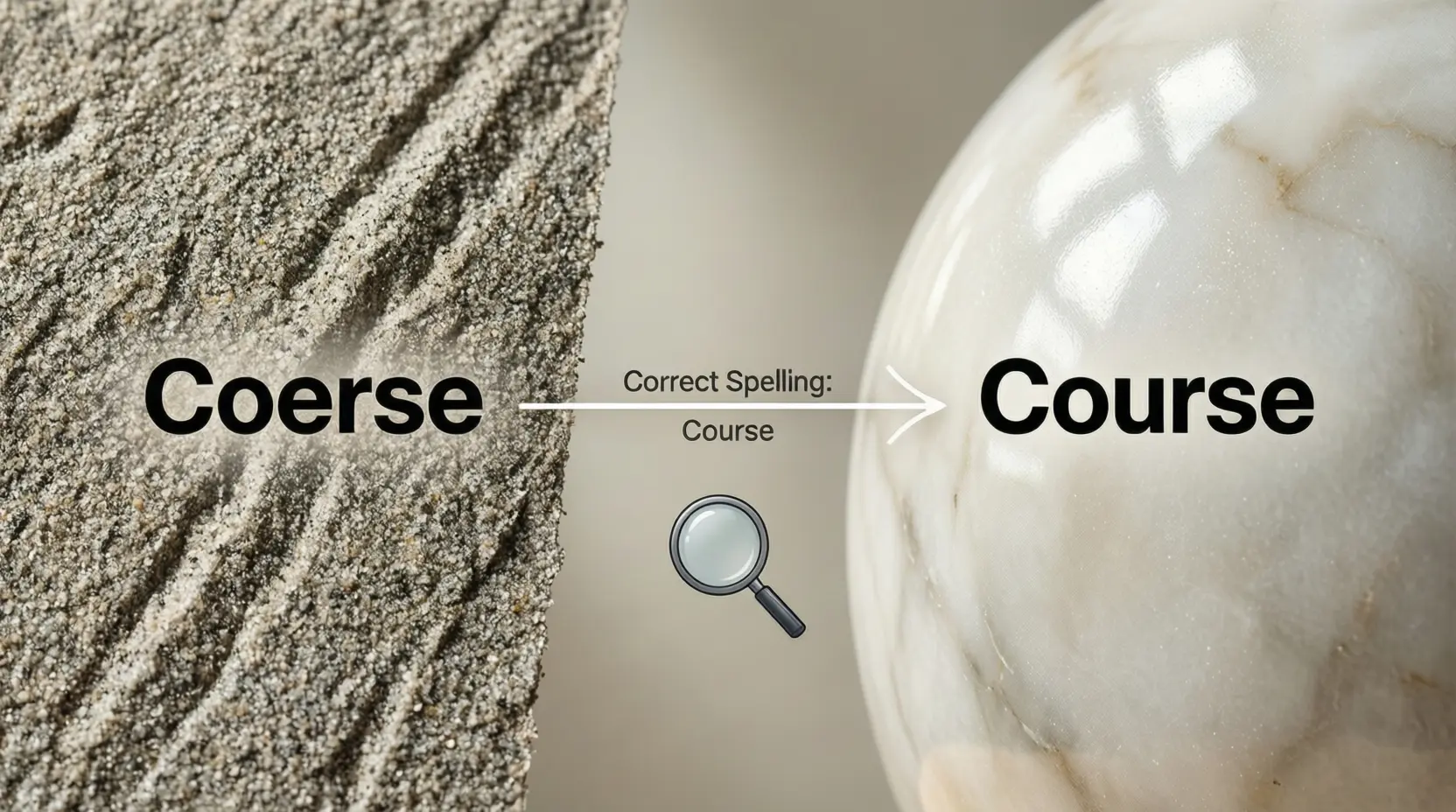
English spelling can be confusing, even for native speakers. One common problem many people face is choosing between coarse and course. These two words look and sound very similar, but their meanings are very different. Because of this, people often type the wrong word in emails, articles, school assignments, and even professional documents.
Many users search for “coarse or course” because spellcheck does not always help. Both words are correct English words, so software cannot tell you which one fits your sentence. This small mistake can change the meaning of your message and make your writing look unprofessional.
For example, saying “I enrolled in a coarse” instead of “I enrolled in a course” is a serious error. In the same way, writing “a course texture” instead of “a coarse texture” sounds strange and incorrect.
This article clears that confusion once and for all. You will learn the exact meanings, origins, correct usage, common mistakes, and real-life examples of coarse and course. By the end, you will know which word to use, when to use it, and why with confidence.
Coarse or Course – Quick Answer
Coarse and course are not interchangeable.
- Coarse means rough, not smooth, or rude in behavior
Example: The sand felt coarse under my feet. - Course means a class, a direction, or a series of steps
Example: I signed up for an online English course.
Simple Tip to Remember
- Coarse = texture or behavior
- Course = class, path, or plan
The Origin of Coarse or Course
Understanding word origins helps reduce spelling mistakes.
Origin of Coarse
The word coarse comes from Old French “cors”, meaning ordinary or rough. Over time, it came to describe things that are rough, grainy, or crude.
Origin of Course
The word course comes from Latin “cursus”, meaning running or path. That is why course is linked to movement, direction, and education.
Why Confusion Exists
Both words:
- Sound almost the same
- Have similar spellings
- Are common in daily English
This makes them classic homophones—words that sound alike but mean different things.
British English vs American English Spelling
Good news!
Coarse and course are spelled the same in both British and American English.
There is no spelling variation, unlike words such as colour/color or recognised/recognized.
Comparison Table
| Word | British English | American English | Meaning |
| Coarse | Coarse | Coarse | Rough or rude |
| Course | Course | Course | Class, direction, or series |
Which Spelling Should You Use?
The correct choice depends on meaning, not country.
Use Coarse if you mean:
- Rough texture
- Grainy material
- Rude language or behavior
Use Course if you mean:
- An educational class
- A direction or path
- A sequence of steps
- A meal (main course)
Audience-Based Advice
- US audience: Same rules apply
- UK/Commonwealth: Same rules apply
- Global audience: Focus on meaning, not spelling style
Common Mistakes with Coarse or Course
Here are frequent errors people make:
❌ Wrong → ✔ Correct
- ❌ I joined a coarse in marketing
✔ I joined a course in marketing - ❌ The road was very course
✔ The road was very coarse - ❌ His words were course
✔ His words were coarse
Why These Mistakes Happen
- Same pronunciation
- Fast typing
- Auto-correct failure
Coarse or Course in Everyday Examples
Emails
- ✔ Please send me the course details.
- ✔ Avoid coarse language in emails.
News
- ✔ The river followed a natural course.
- ✔ The soil is coarse and dry.
Social Media
- ✔ I just finished an online course!
- ✔ This fabric feels too coarse.
Formal Writing
- ✔ The study follows a clear course of action.
- ✔ Coarse materials affect product quality.
Coarse or Course in Academic and Professional Writing
Using the wrong word in formal writing can reduce credibility.
Academic Writing
- ✔ Students must complete the course syllabus.
- ✔ Coarse particles affect filtration results.
Professional Writing
- ✔ This course improves leadership skills.
- ✔ Avoid coarse expressions in the workplace.
Tip for Professionals
Always re-read sentences aloud. If it sounds like a class or plan, use course. If it describes texture or tone, use coarse.
Coarse or Course / Google Trends & Usage Data
Search data shows:
- “Course” is searched more often worldwide
- Popular in education-focused countries like:
- United States
- India
- United Kingdom
- Pakistan
- United States
“Coarse” is searched less but appears in:
- Science
- Manufacturing
- Agriculture
- Behavior-related topics
Most searches for “coarse or course” come from:
- Students
- Content writers
- ESL learners
- Professionals
Comparison Table: Coarse vs Course
| Feature | Coarse | Course |
| Part of Speech | Adjective | Noun |
| Meaning | Rough or rude | Class or direction |
| Used For | Texture, behavior | Education, plan |
| Example | Coarse fabric | Online course |
Exercises: Test Your Understanding
Fill in the Blanks
- I enrolled in a writing ________.
- The rope felt very ________.
- His jokes were ________ and offensive.
Answers:
- Course
- Coarse
- Coarse
Choose the Correct Word
- The river changed its (coarse/course).
✔ Course
Practice Sentences (Write Your Own)
Try writing:
- One sentence using coarse for texture
- One sentence using course for education
This helps lock the meaning in your memory.
FAQs:
1. Are coarse and course interchangeable?
No. They have completely different meanings.
2. Is “coarse” ever used for education?
No. Education always uses course.
3. Can “course” describe food?
Yes. Example: main course.
4. Does “coarse” mean rude?
Yes. It can describe rude language or behavior.
5. Do Americans and British spell these words differently?
No. Both spell them the same.
6. Is “coarse language” correct?
Yes. It means offensive or rude speech.
7. Which word is more common?
Course is more common overall.
Conclusion:
The confusion between coarse or course is common, but it is also easy to fix once you understand the meanings. These words may sound alike, but they serve very different purposes in English. Coarse describes rough textures or rude behavior, while course refers to education, direction, or a planned series of steps.
Using the wrong word can change the meaning of your sentence and harm your writing quality especially in academic, professional, or online content. The good news is that there are no British or American spelling differences to worry about. The only thing that matters is context.
If you remember one thing, remember this:
👉 Texture or tone = coarse
👉 Class or plan = course
With regular practice and careful reading, you will never confuse these two words again.
Read More Article:
Sheath or Sheathe? Correct Meaning, Usage, and Common Mistakes Explained

I hold a degree in English Literature and Linguistics and have worked extensively on educational blogs, comparison websites, and digital learning platforms. My writing focuses on simplifying complex language rules, highlighting British vs American English differences, and providing practical examples for everyday usage.