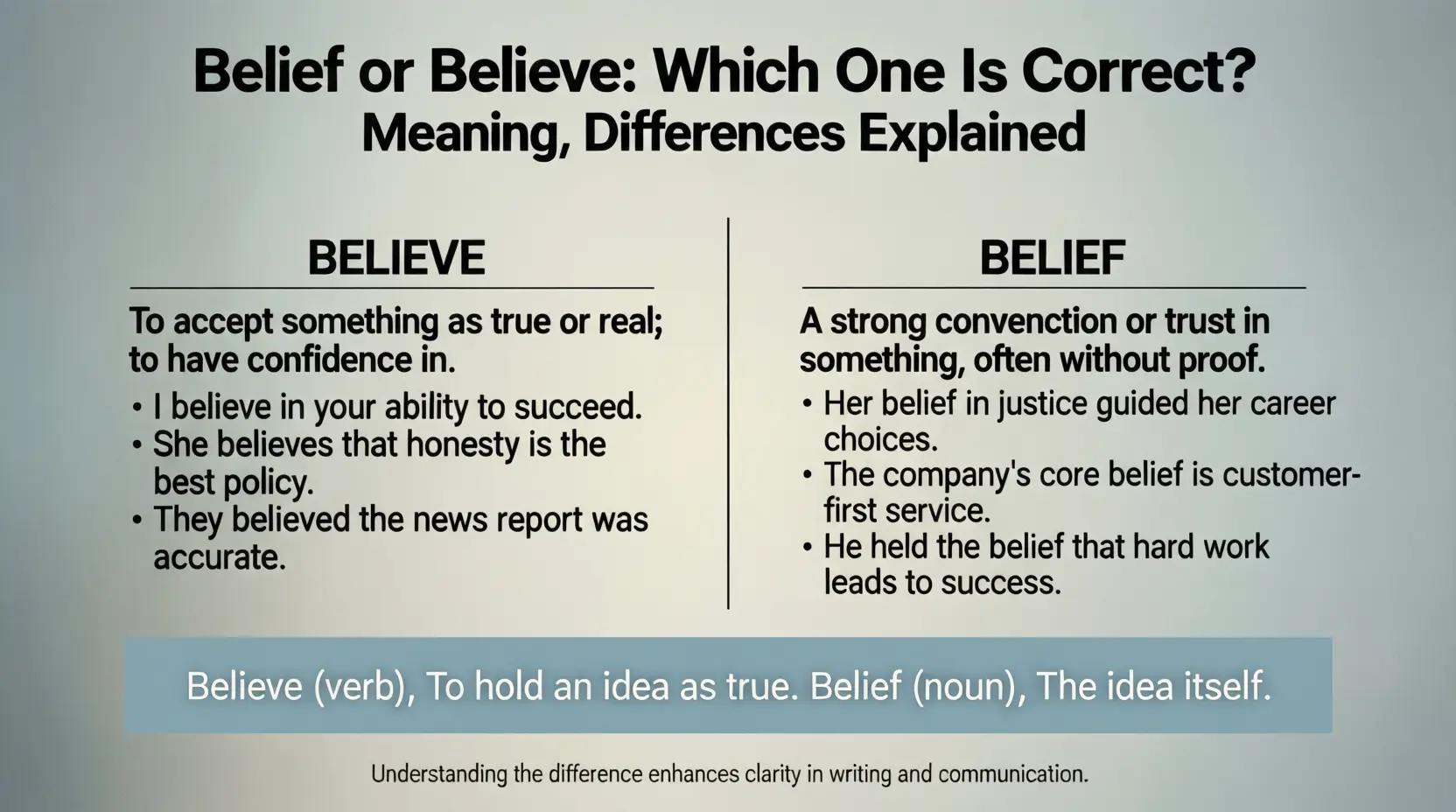
Do you ever stop while writing and think, “Should I use beliefor believehere?” You are not alone. This is one of the most searched English grammar questions online. Students, writers, bloggers, and even professionals often get confused because these two words look and sound very similar but they do very different jobs in a sentence.
People search for “belief or believe” because they want a quick answer, clear rules, and real-life examples. Sometimes the mistake happens in emails. Sometimes it appears in exams, blogs, or social media posts. A small error like this can change the meaning of a sentence or make writing look unprofessional.
This article guides you through the confusion between “belief” and “believe” step by step. You will discover the quick difference between the two words, learn about their origins, and understand how British and American English treat them differently.
It also explains which word you should use depending on your audience, highlights common mistakes to avoid, and shows the correct usage in daily life, academic writing, and professional settings. By the end, you will feel confident using belief and believe correctly every time.
Belief or Believe – Quick Answer
Believe is a verb.
Belief is a noun.
Simple examples:
- I believe in hard work. ✅ (action – thinking)
- Hard work is my belief. ✅ (thing – idea)
Easy rule to remember:
- If it shows an action or feeling in your mind, use believe.
- If it names an idea, thought, or opinion, use belief.
The Origin of Belief or Believe
Both words come from the same root, but they changed over time.
Word history:
- Old English word: “geleafa”
- Meaning: trust, faith, or confidence
Over many years:
- Believe became the verb form (to think something is true)
- Belief became the noun form (the idea or faith itself)
This change happened because English often creates nouns from verbs by adding endings like -f, -th, or -ion. That is why we now have two related but different words.
British English vs American English Spelling
Good news! There is no spelling difference between British and American English for these words.
Same in both:
- Believe ✅
- Belief ✅
Example sentences:
- UK: I believe this is correct.
- US: She has a strong belief in freedom.
Comparison Table
| Feature | British English | American English |
| Believe | Believe | Believe |
| Belief | Belief | Belief |
| Meaning | Same | Same |
| Usage rules | Same | Same |
👉 Unlike colour/color or organise/organize, belief and believe stay the same everywhere.
Which Spelling Should You Use?
Since spelling does not change, your choice depends only on grammar, not location.
Use believe when:
- Writing emails
- Sharing opinions
- Talking about trust or thinking
Example:
- I believe the meeting is tomorrow.
Use belief when:
- Writing essays
- Discussing religion or values
- Talking about ideas or principles
Example:
- Honesty is an important belief.
Audience-based advice:
- US audience: Follow grammar rules (verb vs noun)
- UK/Commonwealth: Same rules apply
- Global audience: Keep sentences simple and clear
Common Mistakes with Belief or Believe
Many learners make these errors:
❌ Mistake 1:
- I have a strong believe in you.
✅ Correct:
- I have a strong belief in you.
❌ Mistake 2
- I belief this story is true.
✅ Correct:
- I believe this story is true.
❌ Mistake 3:
- My believe is different.
✅ Correct:
- My belief is different.
Tip:
If you can add “to” before the word, you need believe.
- I want to believe ✔
- I want to belief ✖
Belief or Believe in Everyday Examples
Emails
- I believe we should start early.
- This is my personal belief.
News
- Experts believe prices will rise.
- The belief in democracy is strong.
Social Media
- I believe in positive thinking 💪
- Self-love is my biggest belief ❤️
Formal Writing
- Researchers believe the results are accurate.
- The belief system of the community matters.
Belief or Believe – Google Trends & Usage Data
Popular usage:
- Believe is searched more because it is used daily in speech.
- Belief is searched often in academic, religious, and motivational topics.
By context:
- Schools & exams → belief
- Conversations → believe
- Blogs & quotes → both
By country:
- USA, UK, Canada, Australia: same usage
- ESL countries: higher confusion rate
👉 This shows why people often search “belief or believe” together.
Belief vs Believe – Comparison Table
| Feature | Belief | Believe |
| Part of speech | Noun | Verb |
| Function | Idea or thought | Action or feeling |
| Can use “to” before? | ❌ No | ✅ Yes |
| Example | A strong belief | I believe you |
| Used in academics | Very common | Common |
Belief or Believe in Academic Writing
In academic writing, accuracy matters.
Use belief when:
- Discussing theories
- Writing philosophy or sociology
- Explaining values or systems
Example:
- The belief system of the culture was studied.
Use believe when:
- Referring to opinions or assumptions
Example:
- Scholars believe the data is reliable.
👉 Mixing them can weaken academic credibility.
Belief or Believe in Professional Writing
In professional settings:
- Emails
- Reports
- Presentations
Examples:
- I believe this strategy will work.
- Our company’s core belief is integrity.
Using the wrong word can make writing look careless, especially in formal communication.
Practice Exercises (Test Yourself)
Exercise 1: Fill in the blanks
- I _______ in teamwork.
- Trust is an important _______.
Answers:
- believe
- belief
Exercise 2: Correct the sentence
- My believe is strong.
✅ Correct:
- My belief is strong.
Exercise 3: Choose the right word
- Scientists (belief / believe) the theory is correct.
✅ Answer:
- believe
FAQs:
1. Is belief a verb?
No. Belief is a noun, not a verb.
2. Is believe a noun?
No. Believe is always a verb.
3. Can belief and believe be used interchangeably?
No. They have different grammar roles.
4. Which one is more formal?
Both are formal when used correctly.
5. Is there a spelling difference in UK and US English?
No. Both use the same spelling.
6. Can belief be plural?
Yes. Beliefs is correct.
7. Is “believe in” correct?
Yes. Example: I believe in you.
8. Which word is used more in exams?
Belief, because it appears in theory-based questions.
Conclusion
The confusion between belief and believe is common, but it is also easy to fix once you understand the core rule. Believe is a verb it shows what you think, trust, or feel. Belief is a noun it names the idea, value, or opinion itself. They come from the same root, but they play different roles in a sentence.
There is no difference between British and American English spelling, which makes learning easier. The real key is choosing the right word based on grammar, not location. In daily conversation, emails, and social media, believe appears more often. In academic, professional, and formal writing, belief is very common.
By using the examples, tables, and exercises in this guide, you can avoid common mistakes and write with confidence. Whether you are a student, blogger, or professional, mastering belief vs believe will make your English clearer, stronger, and more professional.

I hold a degree in English Literature and Linguistics and have worked extensively on educational blogs, comparison websites, and digital learning platforms. My writing focuses on simplifying complex language rules, highlighting British vs American English differences, and providing practical examples for everyday usage.