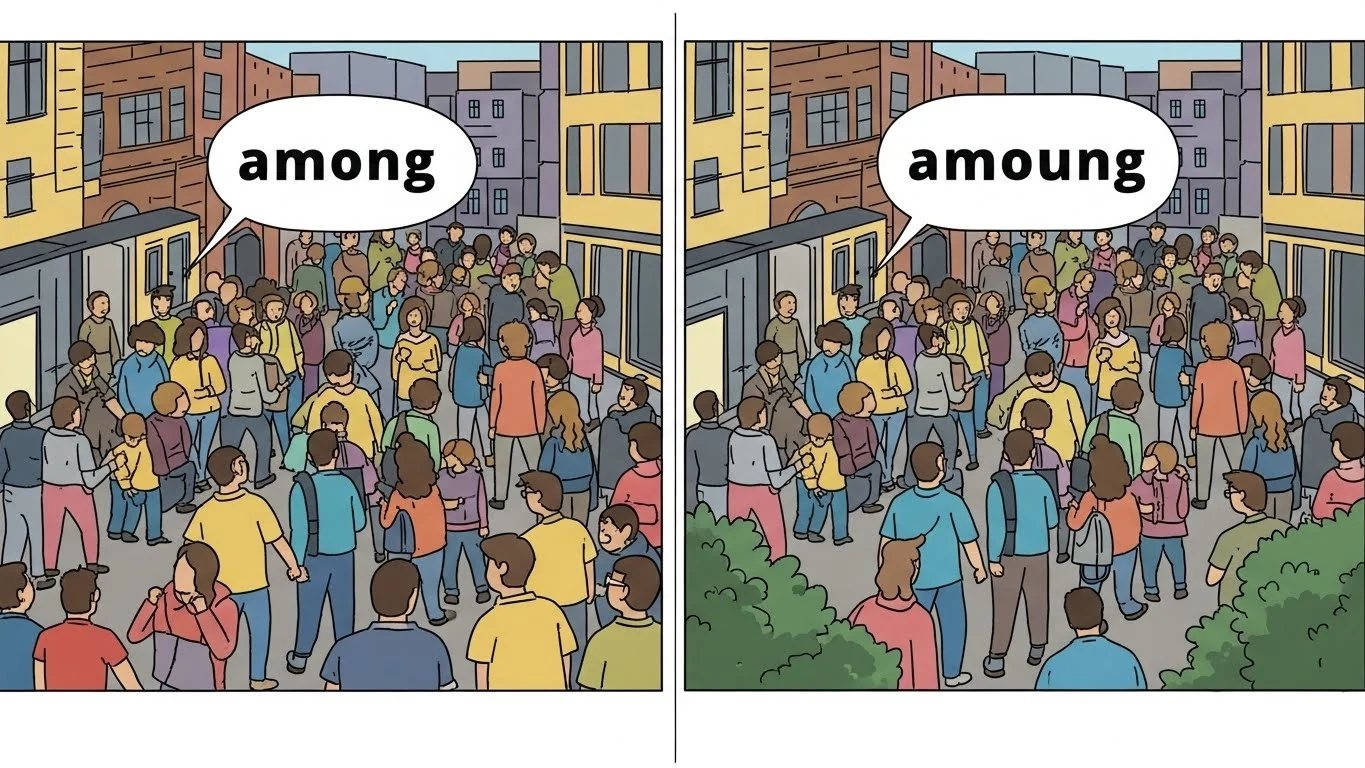
Have you ever paused while writing a sentence and wondered: is it “amoung” or “among”? You are not alone.
This confusion is extremely common, especially for non-native English speakers, students, bloggers, and even professionals.
A single wrong letter can change how polished and trustworthy your writing looks. That is why thousands of people search for “amoung or among” every month.
The confusion usually happens because English spelling is not always logical. Some words sound the same but are spelled very differently.
Others look like they should exist but actually do not. “Amoung” feels right to many writers because it follows patterns seen in words like young or around. But English does not always follow patterns.
This article solves that confusion once and for all. You will get a quick answer, clear examples, historical background, British vs American usage, common mistakes, real-life examples, and practical advice.
By the end, you will never hesitate again when choosing between amoung or among.
Read more about;
Edited or Editted
Cheep or Cheap
Amoung or Among – Quick Answer
The correct spelling is “among.”
“Amoung” is incorrect and not a real word in standard English.
Examples:
- ✅ She felt comfortable among her friends.
- ✅ The money was divided among the team members.
- ❌ She felt comfortable amoung her friends.
- ❌ The prize was shared amoung winners.
No dictionary recognizes amoung as a correct spelling. If you use it in formal writing, emails, or academic work, it will be marked as an error.
The Origin of Amoung or Among
To understand why among is correct and amoung is wrong, we need to look at history.
Where does “among” come from?
The word among comes from Old English “amang” or “gemang,” which meant in a group, mixed with, or surrounded by. Over time, the spelling evolved into among, but the core meaning stayed the same.
Why does “amoung” exist at all?
“Amoung” exists only as a misspelling. It likely appears because:
- English learners hear the “uh” sound and add extra letters.
- Writers confuse it with words like young, sound, or around.
- Autocorrect does not always catch the mistake.
Unlike words such as colour/color, there was never a historical version of amoung in proper English.
British English vs American English Spelling
This is where many people expect a difference. But in this case, there is none.
Key rule:
Both British English and American English use “among.”
There is no regional spelling difference.
Comparison Table
| Feature | British English | American English |
| Correct spelling | among | among |
| Accepted variation | none | none |
| “Amoung” usage | ❌ incorrect | ❌ incorrect |
So whether you are writing for the UK, USA, Australia, Canada, or globally, among is always correct.
Which Spelling Should You Use?
For US audiences:
Use among. It is the only accepted form.
For UK and Commonwealth audiences:
Use among. No alternative exists.
For global or SEO-focused content:
Always use among. Search engines and grammar tools flag amoung as an error.
Professional advice:
If you want your writing to look credible, polished, and native-level, never use “amoung.”
Common Mistakes with Amoung or Among
Here are the most frequent errors writers make:
1. Adding extra letters
- ❌ amoung
- ❌ amoungst
Correct forms:
- ✅ among
- ✅ amongst (British English only, formal)
2. Confusing “among” with “between”
- Among → for groups (3 or more)
- Between → for two items
Examples:
- ✅ The prize was shared among five winners.
- ✅ The deal was made between two companies.
3. Thinking “amoung” is informal
Even informal English does not accept amoung. It is always wrong.
Amoung or Among in Everyday Examples
Emails
- ✅ Please distribute the tasks among the team.
- ❌ Please distribute the tasks amoung the team.
News Writing
- ✅ Tensions rose among political parties.
- ❌ Tensions rose amoung political parties.
Social Media
- ✅ This issue is common among young people.
- ❌ This issue is common amoung young people.
Academic and Formal Writing
- ✅ The data was collected among participants.
- ❌ The data was collected amoung participants.
Amoung or Among – Google Trends & Usage Data
Search engines show a clear pattern:
- “Among” has extremely high usage worldwide.
- “Amoung” appears only in spelling-related searches or errors.
Why people search “amoung or among”:
- English learners checking spelling
- Bloggers proofreading content
- Students avoiding grammar mistakes
- Non-native writers hearing the word but unsure of spelling
Popular regions searching this keyword:
- South Asia
- Middle East
- Africa
- Non-native English countries
This confirms that amoung is not a real alternative, only a common mistake.
Comparison Table: Keyword Variations
| Word | Correct | Usage |
| among | ✅ Yes | Standard English |
| amoung | ❌ No | Spelling mistake |
| amongst | ✅ Yes | British, formal |
| between | ✅ Yes | Used for two items |
FAQs
1. Is “amoung” ever correct?
No. It is always incorrect.
2. Why do people write “amoung”?
Because of pronunciation confusion and pattern guessing.
3. Is “amongst” better than “among”?
No. “Amongst” is formal and British. “Among” is universal.
4. Can I use “among” in academic writing?
Yes. It is fully accepted.
5. Does American English allow “amoung”?
No. Neither American nor British English allows it.
6. Is “among” a preposition?
Yes. It shows relationship or position within a group.
7. How can I remember the correct spelling?
Remember: There is no “u” in among.
Conclusion
The confusion between amoung or among is common, but the solution is simple. Among is the only correct spelling in modern English.
Amoung is always a mistake, regardless of region, context, or writing style. There is no British or American difference here, which makes the rule even easier to follow.
Using the correct spelling improves clarity, credibility, and professionalism. Whether you are writing an email, blog post, academic paper, or social media caption, choosing among ensures your message looks polished and trustworthy.
Language mistakes can distract readers, but correct usage builds confidence.
If you remember just one thing, remember this: there is no “u” in among. Once you lock that into memory, you will never make this mistake again.
Meta Description (20 words):

I am an Emily Carter Brooks U.S.A based linguistics writer known for my clear, reader-friendly explanations of English grammar and vocabulary differences. I have contributed to multiple online language resources and specializes in spelling variations, pronunciation confusion, and British vs American English comparisons. I believes that learning English should be practical, engaging, and stress-free.