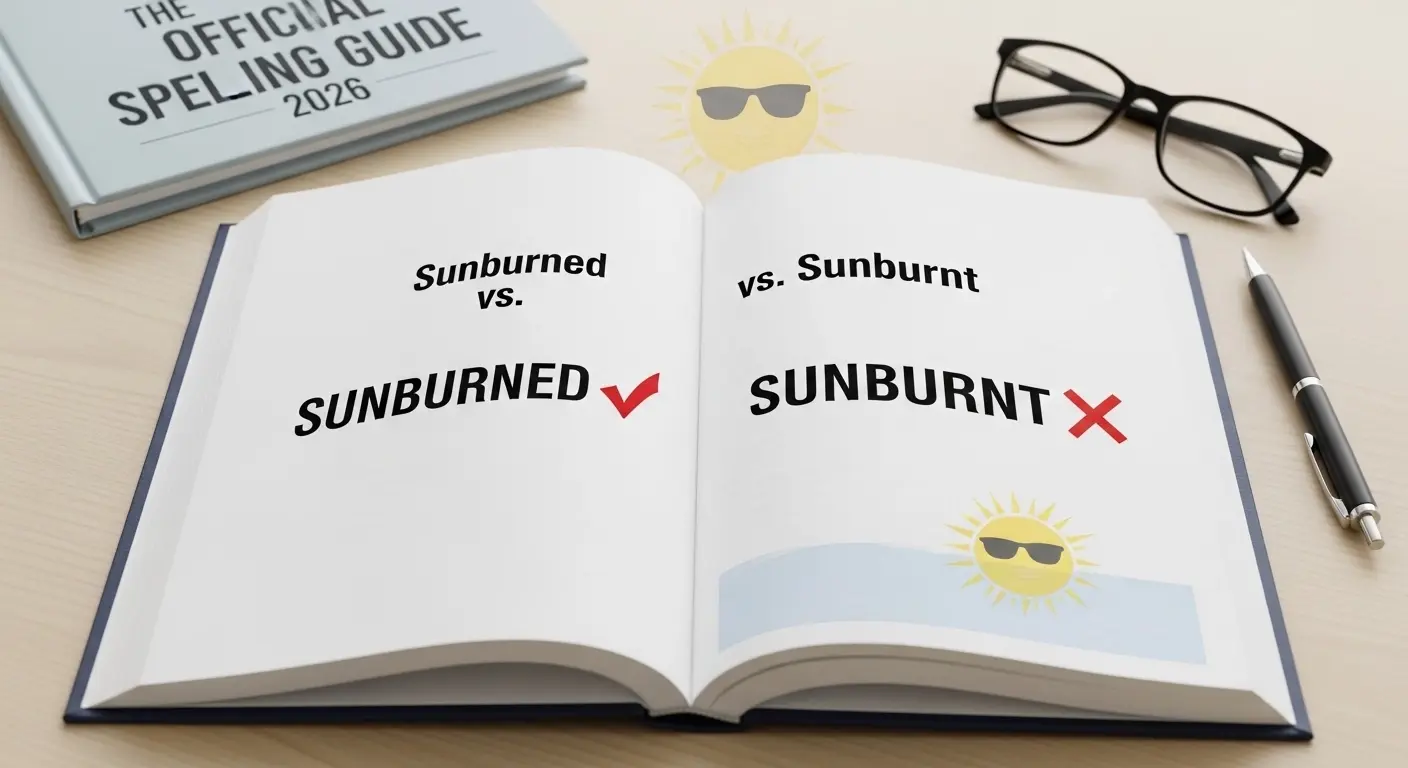
Do you ever wonder whether it’s correct to say “sunburned” or “sunburnt”? Many English speakers get confused because both forms exist, and both seem correct. The difference often depends on where you are in the world and the type of writing you’re doing.
People search for this keyword because they want to avoid embarrassing mistakes in emails, school assignments, or social media posts. This guide will clear up the confusion, explain the origin of both spellings, and show when to use each one.
By the end, you’ll know exactly which spelling works for American English, British English, and global communication. Plus, you’ll get practical examples, common mistakes, and data on how people use these words online.
If you’re writing professionally or casually, this article gives you everything you need to be confident in your choice.
Sunburned or Sunburnt – Quick Answer
Both sunburned and sunburnt are past tense and past participle forms of the verb sunburn.
- Sunburned – Most common in American English. Example: “I got sunburned at the beach yesterday.”
- Sunburnt – Most common in British English. Example: “After the hike, he was completely sunburnt.”
Quick tip: Use sunburned if writing for a U.S. audience and sunburnt for a UK audience. Both are understood globally, but context matters.
The Origin of Sunburned or Sunburnt
The word sunburn comes from combining “sun” and “burn” in Middle English, dating back to the 15th century.
- Early English used sunburnt as the adjective form to describe skin damaged by the sun.
- Sunburned evolved later, especially in American English, following a general pattern of using -ed endings for past participles (like learned vs learnt).
This history explains why two spellings coexist: British English preserved -t, while American English standardized -ed.
British English vs American English Spelling
British and American English differ in many past tense forms ending in -t vs -ed.
| Feature | British English | American English | Example Sentence |
| Past participle ending | -t | -ed | He was sunburnt after the picnic. / He was sunburned after the picnic. |
| Common preference | sunburnt | sunburned | I got sunburnt at the seaside. / I got sunburned at the beach. |
Rule of thumb: British English often keeps -t endings for some verbs (burnt, learnt, dreamt), while American English prefers -ed (burned, learned, dreamed).
Which Spelling Should You Use?
- US Audience: Always use sunburned.
- UK & Commonwealth Countries: Prefer sunburnt, though sunburned is understood.
- Global/Neutral Writing: Either works; consider your audience.
Professional advice: Stick to the spelling consistent with your style guide. For example, APA, Chicago, and MLA style guides accept both, but U.S.-based publishers lean toward sunburned.
Common Mistakes with Sunburned or Sunburnt
- Mixing forms in the same sentence:
❌ “I got sunburnt and my arms are sunburned.”
✅ “I got sunburned, and my arms are still red.” - Using as a noun incorrectly:
❌ “I have a sunburned.”
✅ “I have a sunburn.” - Incorrect past tense usage:
❌ “I sunburnt yesterday at the beach.” (acceptable in UK, but not US)
✅ “I got sunburned yesterday at the beach.” (US standard)
Sunburned or Sunburnt in Everyday Examples
- Email: “Be careful during the company picnic. You don’t want to get sunburned.”
- Social media: “Beach day fun! Totally sunburnt ☀️”
- News article: “Tourists were sunburned after the record-breaking heatwave.”
- Formal writing: “The patient presented with sunburnt skin following prolonged sun exposure.”
Sunburned or Sunburnt – Google Trends & Usage Data
Based on search trends and usage:
- Sunburned dominates in the United States, especially in summer months.
- Sunburnt is more common in the UK, Australia, and New Zealand.
- Globally, both terms are recognized, but online content targeting U.S. readers favors sunburned.
| Term | Popularity Region | Peak Season |
| sunburned | USA, Canada | June–August |
| sunburnt | UK, Australia, NZ | December–February (Southern Hemisphere summer) |
Keyword Comparison Table
| Variation | Region/Preference | Example |
| sunburned | US | I got sunburned on vacation. |
| sunburnt | UK & Commonwealth | She was sunburnt after hiking. |
FAQs:
- Is sunburned or sunburnt correct?
Both are correct; choice depends on audience and region. - Can I use sunburnt in the U.S.?
Yes, but it’s less common and may appear old-fashioned. - Is there a difference in meaning?
No, both describe skin damaged by sun exposure. - Which style guide prefers sunburned?
U.S.-based guides like APA, Chicago, and MLA. - Are there other verbs like this?
Yes, verbs like learned/learnt, dreamed/dreamt, burnt/burned follow the same pattern. - Can I use sunburnt as an adjective?
Yes, e.g., “Her sunburnt shoulders were red.” - Is sunburned used as an adjective too?
Yes, e.g., “He had sunburned arms after the hike.” - Which is better for social media?
Use the version your audience recognizes; casual content often favors local spelling. - Do dictionaries accept both forms?
Yes, most English dictionaries list both with regional notes.
Conclusion:
Both sunburned and sunburnt are correct past tense forms of sunburn, but their use depends on geography and audience. Americans almost always prefer sunburned, while British and Commonwealth countries lean toward sunburnt. Understanding these differences ensures your writing is polished, professional, and audience-appropriate. When writing globally, context matters, but either spelling is generally understood.
Remember common mistakes like mixing forms, incorrect past tense usage, and treating the word as a noun. With these insights, you can confidently use sunburned or sunburnt in emails, social media posts, news articles, and formal writing.
This knowledge not only helps you write correctly but also prevents embarrassing errors that can affect your credibility, especially in professional or educational settings. Ultimately, knowing your audience is key, and using consistent spelling improves clarity, style, and reader trust.

I am an Emily Carter Brooks U.S.A based linguistics writer known for my clear, reader-friendly explanations of English grammar and vocabulary differences. I have contributed to multiple online language resources and specializes in spelling variations, pronunciation confusion, and British vs American English comparisons. I believes that learning English should be practical, engaging, and stress-free.