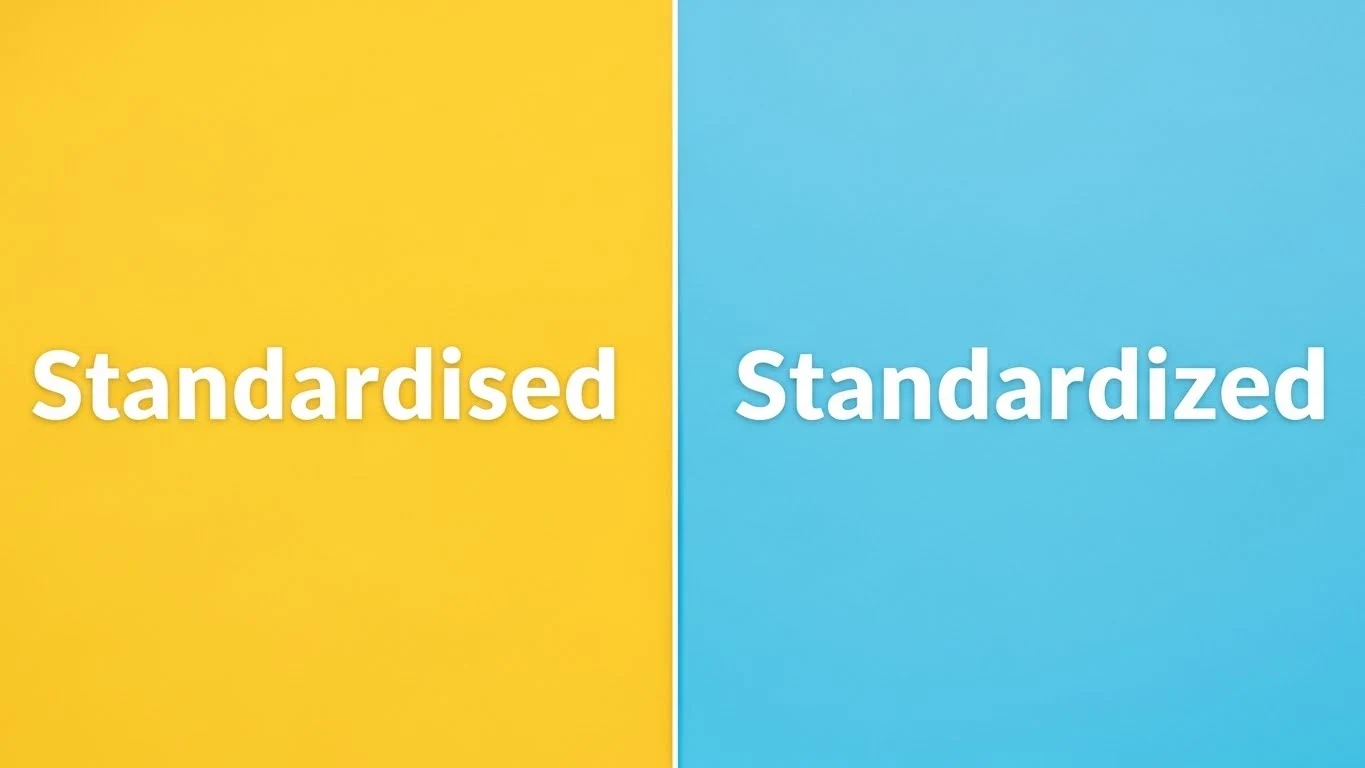
Have you ever paused while writing and wondered whether to use standardised or standardized? You’re not alone. This is one of the most common spelling questions in English, especially for writers, students, marketers, and professionals working across borders. A single letter can feel surprisingly important when clarity and credibility matter.
People search for standardised or standardized because both spellings appear correct. You’ll see one used in British articles and the other in American reports. This causes confusion, especially when writing for global audiences, academic work, or SEO-focused content where consistency matters.
This article clears up that confusion once and for all. You’ll get a quick answer, learn where the spellings come from, and understand why English has two versions. We’ll compare British and American rules, show real-life examples, and help you choose the right spelling for your audience. By the end, you’ll know exactly when to use standardised and when standardized—with confidence.
Read more about;
kilm-or-kiln
Standardised or Standardized – Quick Answer
Both standardised and standardized are correct.
- Standardised is British English
Example: The test was standardised across UK schools. - Standardized is American English
Example: The process was standardized across US factories.
The meaning is the same in both cases. Only the spelling changes.
The Origin of Standardised or Standardized
The word standardize comes from the noun standard, meaning a set rule or model. The verb form developed to describe making things uniform.
The spelling difference comes from history. British English kept -ise, influenced by French and Greek roots. American English later adopted -ize, guided by dictionary reformer Noah Webster.
That is why English has two accepted spellings today. Neither is more “correct.” They simply follow different regional rules.
British English vs American English Spelling
British and American English often differ with -ise and -ize endings.
Key Differences
| British English | American English |
| standardised | standardized |
| organised | organized |
| recognised | recognized |
| customised | customized |
British English prefers -ise, while American English uses -ize consistently.
Which Spelling Should You Use?
Your audience decides the spelling.
- US audience: Use standardized
- UK audience: Use standardised
- Australia, Canada, India: Usually standardised
- Global or SEO content: Choose one style and stay consistent
For academic or corporate writing, follow the style guide you are given.
Common Mistakes with Standardised or Standardized
Here are frequent errors:
- ❌ Mixing spellings in one document
✅ Pick one and stay consistent - ❌ Assuming one spelling is wrong
✅ Both are correct - ❌ Using US spelling in UK exams
✅ Match the regional standard
Standardised or Standardized in Everyday Examples
Email:
“The data has been standardized for reporting.”
News:
“The system was standardised across hospitals.”
Social Media:
“We finally standardized our workflow!”
Formal Writing:
“All procedures were standardised before approval.”
Standardised or Standardized – Google Trends & Usage Data
Search data shows clear regional patterns.
- Standardized is most searched in the United States
- Standardised dominates in the UK, Australia, and India
- Global brands often pick one spelling for consistency
Both terms have strong search volume, depending on location and industry.
Comparison Table: Keyword Variations
| Term | Region | Correct Usage |
| standardised | UK / Commonwealth | ✔ |
| standardized | United States | ✔ |
| standardise | UK verb form | ✔ |
| standardize | US verb form | ✔ |
FAQs
1. Is standardised British English?
Yes, it follows British spelling rules.
2. Is standardized American English?
Yes, it is the standard US spelling.
3. Do they mean the same thing?
Yes, the meaning is identical.
4. Which spelling is better for SEO?
Use the version your target audience searches for.
5. Can I use both in one article?
No, consistency is important.
6. Which spelling should students use?
Follow your school or country’s guidelines.
7. Is one spelling more formal?
No, both are equally formal.
Conclusion
The choice between standardised or standardized is not about right or wrong. It is about audience and consistency. Both spellings mean the same thing and are fully accepted in English. The difference comes from regional language rules, not grammar mistakes.
If you write for a US audience, standardized is the best choice. For UK and Commonwealth readers, standardised feels natural and correct. When writing global content, choose one spelling and use it throughout the text.
Understanding this small difference helps you write with confidence. It also improves clarity, professionalism, and SEO performance. Once you know the rule, the confusion disappears. Pick the spelling that fits your readers—and stick with it.

I am an Emily Carter Brooks U.S.A based linguistics writer known for my clear, reader-friendly explanations of English grammar and vocabulary differences. I have contributed to multiple online language resources and specializes in spelling variations, pronunciation confusion, and British vs American English comparisons. I believes that learning English should be practical, engaging, and stress-free.