When it comes to English spelling, few words cause as much confusion as phase and faze. People often wonder: are they interchangeable, or does each have a distinct meaning? The confusion is understandable.
Both words sound alike when spoken, but their meanings are completely different. Using the wrong one in an email, essay, or social media post can make your writing look unprofessional.
This guide is designed to clarify the difference between phase and faze, explain their origins, and provide clear examples for British and American English. By the end, you’ll know exactly when to use each word, common mistakes to avoid, and even the subtle differences in usage across countries.
If you are a student, professional, or just someone who writes online, this article will give you confidence in using the correct spelling every time.
Phase or Faze – Quick Answer
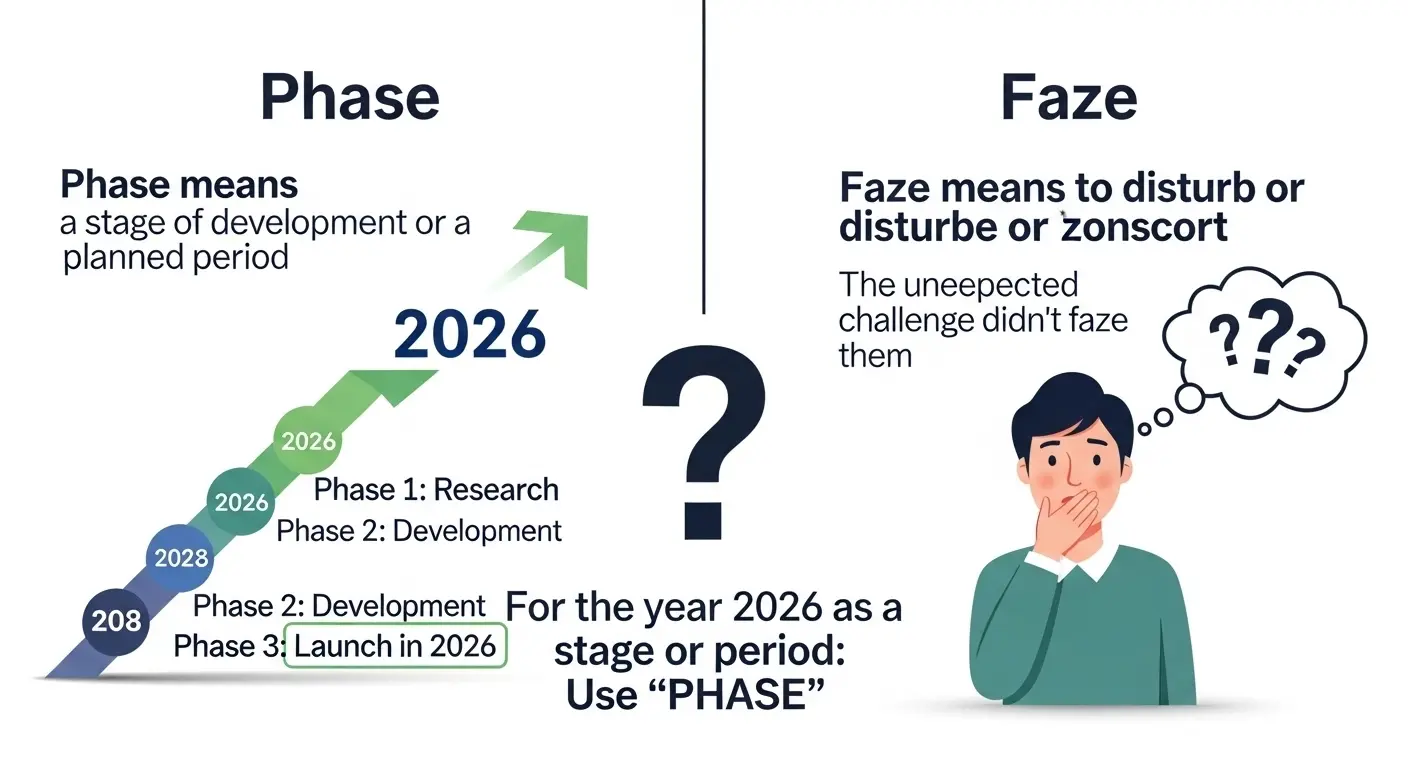
Phase is a noun or verb referring to a stage in a process or development.
- Example (noun): “The project is in its final phase.”
- Example (verb): “We will phase in the new policy gradually.”
Faze is a verb meaning to disturb, worry, or unsettle someone.
- Example: “She wasn’t fazed by the criticism.”
Quick Tip: If you are talking about stages, use phase. If you are talking about being disturbed or worried, use faze.
The Origin of Phase and Faze
Phase comes from the Greek word phasis, meaning “appearance” or “stage of a process.” It entered English in the 16th century, mainly in scientific and philosophical contexts, referring to stages of the moon, experiments, or plans.
Faze emerged in English around the 16th–17th century, probably influenced by Scots and northern English dialects, meaning “to frighten or disconcert.” Over time, its usage became informal, commonly used in speech and casual writing.
The different origins explain why these words mean completely different things despite sounding alike.
British English vs American English Spelling
Interestingly, phase and faze are spelled the same in both British and American English. There is no regional spelling difference; the challenge is knowing which word fits the context.
| Word | Meaning | Usage Example (UK) | Usage Example (US) |
| Phase | Stage or step | “The building project is in the final phase.” | “We are phasing in the new software.” |
| Faze | To disturb or unsettle | “He was not fazed by the rain.” | “She wasn’t fazed by the tough interview.” |
Which Spelling Should You Use?
- United States: Use phase for stages and faze for disturbance.
- United Kingdom & Commonwealth: Same rule applies; no spelling change.
- Global audience: Stick with phase for professional, formal writing; faze can appear in informal contexts like social media.
Professional Tip: Always double-check context. If in doubt, remember: phase = process/stage, faze = worry/disturb.
Common Mistakes with Phase or Faze
Many people misuse these words because they sound identical.
- ❌ “The new policy will faze out gradually.” → Incorrect
- ✅ “The new policy will phase out gradually.” → Correct
- ❌ “He was phased by the noise.” → Incorrect
- ✅ “He was fazed by the noise.” → Correct
- ❌ “The project is in its final faze.” → Incorrect
- ✅ “The project is in its final phase.” → Correct
Phase or Faze in Everyday Examples
Emails:
- “We are phasing in the new schedule next month.” ✅
- “Don’t let criticism faze you; stay confident.” ✅
News Headlines:
- “Scientists announce next phase of Mars mission.” ✅
- “CEO wasn’t fazed by shareholder questions.” ✅
Social Media:
- “This rollercoaster didn’t faze me at all!” ✅
- “Phasing out old features to improve the app.” ✅
Formal Writing:
- “Each phase of the experiment was carefully documented.” ✅
- “The unexpected results did not faze the researchers.” ✅
Phase or Faze – Google Trends & Usage Data
Google Trends shows phase is far more common in search queries, largely due to its use in education, projects, and science.
- Top countries searching phase: US, UK, India, Canada.
- Top countries searching faze: US, UK, Canada (mostly informal contexts).
Contextual Insight: Most people search “phase” when looking for guidance on processes, stages, or life events. “Faze” searches are typically about emotional responses or slang usage.
Comparison Table
| Feature | Phase | Faze |
| Part of Speech | Noun / Verb | Verb |
| Meaning | Stage, step, or process | To disturb or unsettle |
| British & American | Same | Same |
| Formal Writing | Yes | Rare |
| Informal Writing | Yes | Common |
| Common Mistake | Confused with “faze” | Confused with “phase” |
FAQs:
1. Can I use “faze” to mean a stage?
No. Only phase refers to stages or steps.
2. Is “phase” ever a verb?
Yes. Example: “We will phase in the new rules.”
3. Can “faze” be used in formal writing?
Rarely. It is mostly informal.
4. Are there any British vs American differences?
No spelling difference; usage rules are the same.
5. How do I remember the difference?
Think: phase = process/stage, faze = upset/disturb.
6. Is “phased” different from “fazed”?
Yes. “Phased” relates to stages; “fazed” relates to emotional disturbance.
7. Can “faze” be used in social media?
Absolutely. Example: “The challenge didn’t faze me!”
8. Which word is more common in academic writing?
Phase is far more common due to technical and process-based contexts.
9. Are there idioms with “faze”?
Yes. “Not fazed by” means remaining calm despite pressure.
Conclusion:
Understanding the difference between phase and faze is essential for clear, professional writing. While both words sound identical, their meanings couldn’t be more different. Phase deals with stages, steps, or processes, and is suitable for formal, professional, and academic contexts. Faze, on the other hand, refers to emotional disturbance and is more common in informal speech, social media, and casual writing.
By remembering simple rules phase = stage, faze = worry you can avoid common mistakes, enhance your writing, and communicate confidently across emails, news, or online posts. Always consider your audience: use phase for global or professional communication, and faze for informal or personal contexts. With careful usage, you’ll ensure that your writing is precise, polished, and easily understood by readers worldwide.

I hold a degree in English Literature and Linguistics and have worked extensively on educational blogs, comparison websites, and digital learning platforms. My writing focuses on simplifying complex language rules, highlighting British vs American English differences, and providing practical examples for everyday usage.