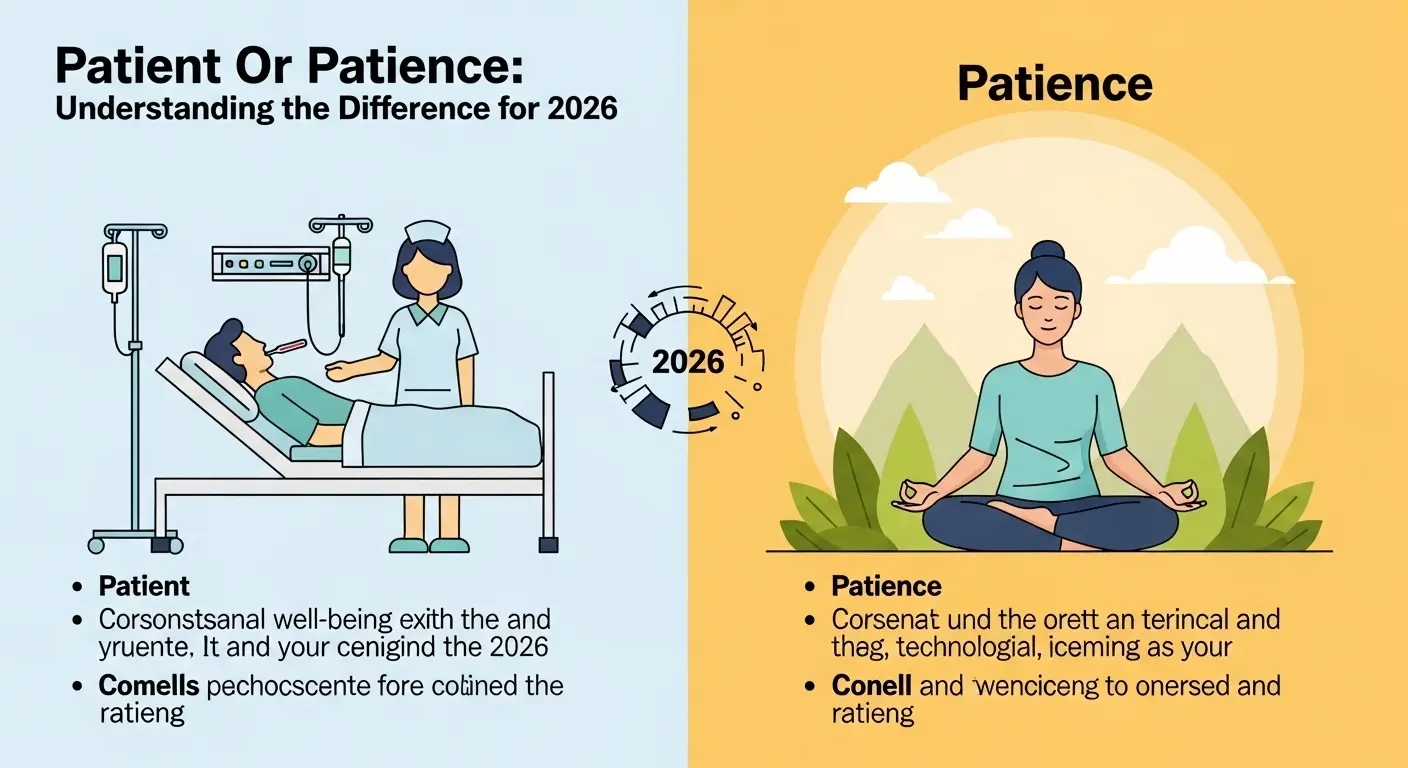
Have you ever wondered whether to write patient or patience? These two words often confuse learners and even native speakers. One is an adjective or noun related to healthcare, while the other describes the ability to stay calm in difficult situations. Knowing which word to use is important for writing, professional communication, and exams.
People often search for “patient or patience” when they want to avoid embarrassing mistakes in emails, essays, or social media posts. Misusing these words can change the meaning of a sentence entirely.
For example, saying “He showed patient during the meeting” is incorrect because “patient” refers to a person receiving medical care, not the quality of being calm. Understanding the difference can make your writing clear and professional.
This guide will explain the difference, origin, spelling, usage, and common mistakes of patient and patience, helping you write confidently in any context.
Patient or Patience – Quick Answer
- Patient (noun): A person receiving medical care.
Example: The patient waited quietly in the clinic. - Patient (adjective): Able to stay calm without getting annoyed.
Example: She is very patient with her students. - Patience (noun): The quality of being able to wait calmly or endure difficulties.
Example: Developing new skills requires patience.
Quick Tip: If you are talking about someone in a hospital or clinic, use patient. If you are talking about calmness or tolerance, use patience.
The Origin of Patient and Patience
Both patient and patience come from the Latin word patiens, meaning “suffering” or “enduring.”
- Patient entered English in the 14th century to describe someone who suffers illness (noun) or someone who endures with calmness (adjective).
- Patience became the abstract noun form, meaning the ability to endure or wait without complaint.
Over centuries, English developed these two forms to distinguish between the person (patient) and the quality (patience). This helps avoid confusion in professional and daily writing.
British English vs American English Spelling
Both patient and patience are spelled the same in British and American English. However, there are slight differences in related words like “practice” (UK: practise for verb) or medical terms.
| Word | British English | American English | Example |
| Patient | patient | patient | The patient was admitted yesterday. |
| Patience | patience | patience | Good patience helps in teaching. |
| Practice (noun) | practice | practice | He runs a medical practice. |
| Practise (verb) | practise | practice | Doctors practise medicine daily. |
Note: The main difference in US vs UK spelling doesn’t affect “patient” or “patience,” making them safe for both audiences.
Which Spelling Should You Use?
Since the spelling is consistent globally, your choice depends on context, not geography:
- US & Canada: Both words are standard. Use them exactly as above.
- UK & Commonwealth countries: Same spelling, but remember related verbs like practise may differ.
- Global audiences: Stick to the rules above to avoid confusion.
Tip: Focus on correct usage rather than worrying about regional spelling for these words.
Common Mistakes with Patient or Patience
Many errors arise from confusing the noun/adjective patient with the noun patience.
| Incorrect | Correct | Explanation |
| He has a lot of patient. | He has a lot of patience. | Refers to the quality, not a person. |
| The patience waited in line. | The patient waited in line. | Refers to a person receiving care. |
| Be patience with your work. | Be patient with your work. | Adjective needed, not noun. |
Tip: Ask yourself: Are you describing a person (patient) or a quality/trait (patience)?
Patient or Patience in Everyday Examples
Emails:
- Correct: “Please be patient while we process your request.”
- Correct: “Thank you for your patience during this busy season.”
News:
- “The patient is recovering well after surgery.”
- “Authorities ask for public patience amid delays.”
Social Media:
- “Learning guitar needs a lot of patience!”
- “Stay patient good things take time.”
Formal Writing:
- “Healthcare patients require compassionate care.”
- “Project success depends on patience and teamwork.”
Patient or Patience – Google Trends & Usage Data
Based on Google Trends:
- Searches for “patient” spike in medical or hospital-related contexts.
- Searches for “patience” increase in education, self-help, and lifestyle topics.
- Globally, patience is slightly more searched than patient, likely due to broader life applications.
Key Insight: The context of your audience should guide your choice more than frequency.
Comparison Table – Patient vs Patience
| Feature | Patient | Patience |
| Part of Speech | Noun / Adjective | Noun |
| Meaning | Person receiving care / able to wait calmly | Ability to remain calm or endure difficulties |
| Usage | Healthcare, personal traits | Calmness, tolerance, endurance |
| Example | “The patient waited for the doctor.” | “It takes patience to learn a new skill.” |
FAQs
- Can “patient” mean calm?
Yes, as an adjective: She is very patient with children. - Is “patience” only a noun?
Yes, it always refers to the quality of being calm. - Do British and American English spell these differently?
No, both spellings are identical. - Which is correct: “Have patient” or “Have patience”?
Correct: Have patience because it is the quality you are asking for. - Can “patient” be plural?
Yes: The patients are waiting in the lobby. - Is “patience” countable?
No, it is usually uncountable: She showed great patience. - Can I use “patient” in social media?
Yes, as an adjective: Be patient, good things are coming. - Is it okay to confuse these words in casual writing?
It’s common, but for professional or formal writing, accuracy is important.
Conclusion:
Understanding the difference between patient and patience is simple once you know the rules. Patient refers to a person receiving medical care or someone who remains calm, while patience is the abstract quality of endurance and tolerance. Both words are spelled the same in British and American English, so the key is using them correctly in context.
Mistakes often arise when people mix the noun/adjective patient with the quality patience, but a simple check asking “am I talking about a person or a trait?” can prevent errors.
Using these words correctly improves clarity in emails, social media, academic writing, and professional communication. Remember: being patient and showing patience are skills that extend beyond words they reflect professionalism and composure. By practicing these distinctions, you’ll write with confidence, avoiding common pitfalls, and ensuring your messages convey exactly what you mean.

I hold a degree in English Literature and Linguistics and have worked extensively on educational blogs, comparison websites, and digital learning platforms. My writing focuses on simplifying complex language rules, highlighting British vs American English differences, and providing practical examples for everyday usage.