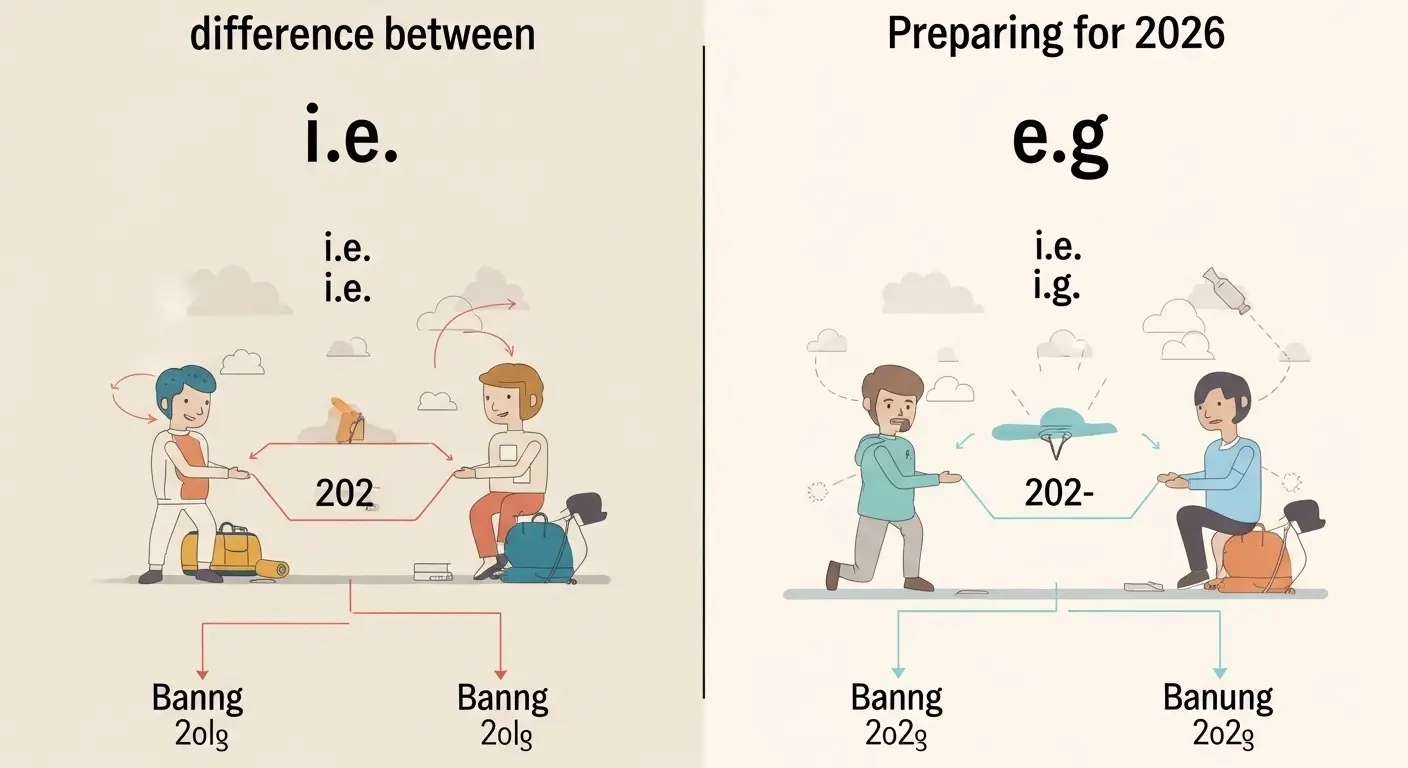
Have you ever stumbled over i.e. and e.g. while writing emails, reports, or social media posts? These tiny abbreviations are some of the most commonly confused in English. Using them incorrectly can make your writing unclear or even misleading.
People often search for “ie or eg” because they want a quick guide to remember which means “that is” and which means “for example.”
Many writers mix them up because they both introduce clarifications or details, but the difference is subtle yet important. i.e. explains or restates something, while e.g. gives examples. Understanding the distinction can improve your professional writing, save readers from confusion, and even enhance your credibility in formal communications.
In this guide, we’ll break down i.e. vs e.g., explore their origins, compare British and American usage, highlight common mistakes, and provide practical examples. By the end, you’ll know exactly which abbreviation to use in emails, reports, social media, or any professional context.
i.e. or e.g. – Quick Answer
- i.e. (id est) → Means “that is” or “in other words.” Use it to clarify or restate.
Example: I prefer citrus fruits, i.e. oranges and lemons. - e.g. (exempli gratia) → Means “for example.” Use it to provide examples without limiting the list.
Example: I like citrus fruits, e.g. oranges, lemons, and limes.
Tip: If you can replace the abbreviation with “in other words,” it’s i.e.; if you can replace it with “for example,” it’s e.g.
The Origin of i.e. and e.g.
Both abbreviations come from Latin:
- i.e. stands for id est, literally meaning “that is.” Its purpose is to restate or clarify a statement.
- e.g. stands for exempli gratia, literally meaning “for the sake of example.” It introduces examples without suggesting the list is complete.
These abbreviations have been used in English writing since the early modern period (16th–17th century) and were originally more common in formal, scholarly, and legal texts. Over time, they entered everyday writing and digital communication, often appearing in emails, articles, and textbooks.
British English vs American English Spelling
Both British and American English use i.e. and e.g., but there are slight stylistic differences in punctuation and spacing.
| Abbreviation | British English Style | American English Style |
| i.e. | i.e., (with comma optional) | i.e., (comma recommended) |
| e.g. | e.g., (comma optional) | e.g., (comma recommended) |
| Usage | Often more formal | Common in both formal and informal writing |
| Spacing | Usually a space after period | Usually a space after period |
Key Point: Both styles place a space after the period, but Americans often include a comma after the abbreviation.
Which Spelling Should You Use?
- US audience: Use i.e., and e.g., with the comma. It’s standard in American writing style guides.
- UK and Commonwealth audience: i.e. and e.g. without the comma are acceptable in formal writing, though adding the comma is also understood.
- Global audience: Focus on clarity. If you’re writing for mixed readers, a small note like “i.e., that is” can prevent confusion.
Common Mistakes with i.e. and e.g.
- Mixing them up
❌ I love citrus fruits, i.e., oranges and lemons. (wrong if you meant “for example”)
✅ I love citrus fruits, e.g., oranges and lemons. - Omitting periods (less formal but sometimes accepted in digital writing)
❌ I like fruits eg oranges.
✅ I like fruits, e.g., oranges. - Using i.e. for a list of examples
❌ I like fruits, i.e., oranges, lemons, and limes.
✅ I like fruits, e.g., oranges, lemons, and limes. - Confusing with “that is” meaning
✅ I enjoy citrus fruits, i.e., fruits high in vitamin C. (Correct clarification)
i.e. and e.g. in Everyday Examples
Emails:
- Please submit the reports by Monday, i.e. two days from today.
- We can focus on summer fruits, e.g. mangoes, peaches, and melons.
News:
- The city banned certain vehicles, i.e., older diesel models.
- Several tech companies, e.g. Apple and Microsoft, are investing in AI.
Social Media:
- Love tropical vacations, i.e., beaches and sunshine!
- My favorite hobbies, e.g. reading and hiking, keep me relaxed.
Formal Writing:
- The results were conclusive, i.e., they confirmed the hypothesis.
- Renewable energy sources, e.g. solar and wind, are gaining popularity.
i.e. or e.g. – Google Trends & Usage Data
Google Trends shows that globally, searches for “i.e. vs e.g.” spike around exam seasons and in business writing contexts. The USA dominates searches slightly more than the UK. On platforms like LinkedIn and Medium, i.e. is often used in professional summaries, whereas e.g. appears in blog posts, guides, and example lists.
Keyword Comparison Table
| Feature | i.e. | e.g. |
| Meaning | That is / in other words | For example |
| Purpose | Clarify or restate | Provide examples |
| Example | I like citrus fruits, i.e., oranges and lemons | I like citrus fruits, e.g., oranges, lemons, and limes |
| Common Mistake | Using for examples | Using to clarify |
| Region Notes | Formal & informal (US/UK) | Formal & informal (US/UK) |
FAQs:
- Can I use i.e. and e.g. interchangeably?
❌ No, i.e. clarifies, e.g. gives examples. - Should I use a comma after i.e. and e.g.?
✔ In American English, yes. In British English, optional. - Is it okay to omit periods?
✔ In casual writing, yes. In formal writing, periods are recommended. - Do I capitalize i.e. or e.g.?
❌ Never capitalize unless starting a sentence. - Can I replace i.e. with “that is”?
✔ Yes, that’s the easiest way to check if you’re using it correctly. - Can I replace e.g. with “for example”?
✔ Absolutely, it clarifies meaning for all readers. - Are i.e. and e.g. used in both emails and formal papers?
✔ Yes, but always ensure correct usage depending on context. - Which abbreviation is more common online?
✔ e.g. appears slightly more in blogs and examples lists. - Do non-native speakers often confuse them?
✔ Yes, this is one of the most common writing errors in English.
Conclusion:
Understanding i.e. vs e.g. is essential for clear, professional writing. Remember: i.e. restates or clarifies, while e.g. provides examples. Misusing them can confuse your reader, especially in formal documents, emails, or publications.
While both abbreviations have Latin origins, modern usage favors slight stylistic differences between British and American English. In the US, commas are typically included after the abbreviation, whereas in the UK, they are optional. When writing for a global audience, clarity is paramount consider spelling out “that is” or “for example” when necessary.
With this guide, you now have a quick reference, practical examples, and insight into common mistakes. By practicing correct usage, your writing will become precise, professional, and easier for readers to understand. If drafting reports, emails, or social media posts, knowing the difference between i.e. and e.g. can save you from small but impactful errors.

I am an Emily Carter Brooks U.S.A based linguistics writer known for my clear, reader-friendly explanations of English grammar and vocabulary differences. I have contributed to multiple online language resources and specializes in spelling variations, pronunciation confusion, and British vs American English comparisons. I believes that learning English should be practical, engaging, and stress-free.