Have you ever paused while writing and wondered: Should I use “farthest” or “furthest”? You’re not alone. Many English learners and even native speakers search for this keyword because both words seem almost identical. They often appear in similar sentences, which creates confusion.
The problem is simple: both “farthest” and “furthest” are correct but they are not always used the same way. Some people think the difference is about British vs American English. Others believe one is more formal than the other. This mix of rules makes it hard to choose the right word.
This article solves that confusion. You’ll learn the exact difference between “farthest” and “furthest,” when to use each one, and how to avoid common mistakes. We’ll also look at their history, real-life examples, and usage trends across countries.
By the end, you will feel confident using both words in emails, writing, and daily conversations.
Farthest or Furthest – Quick Answer
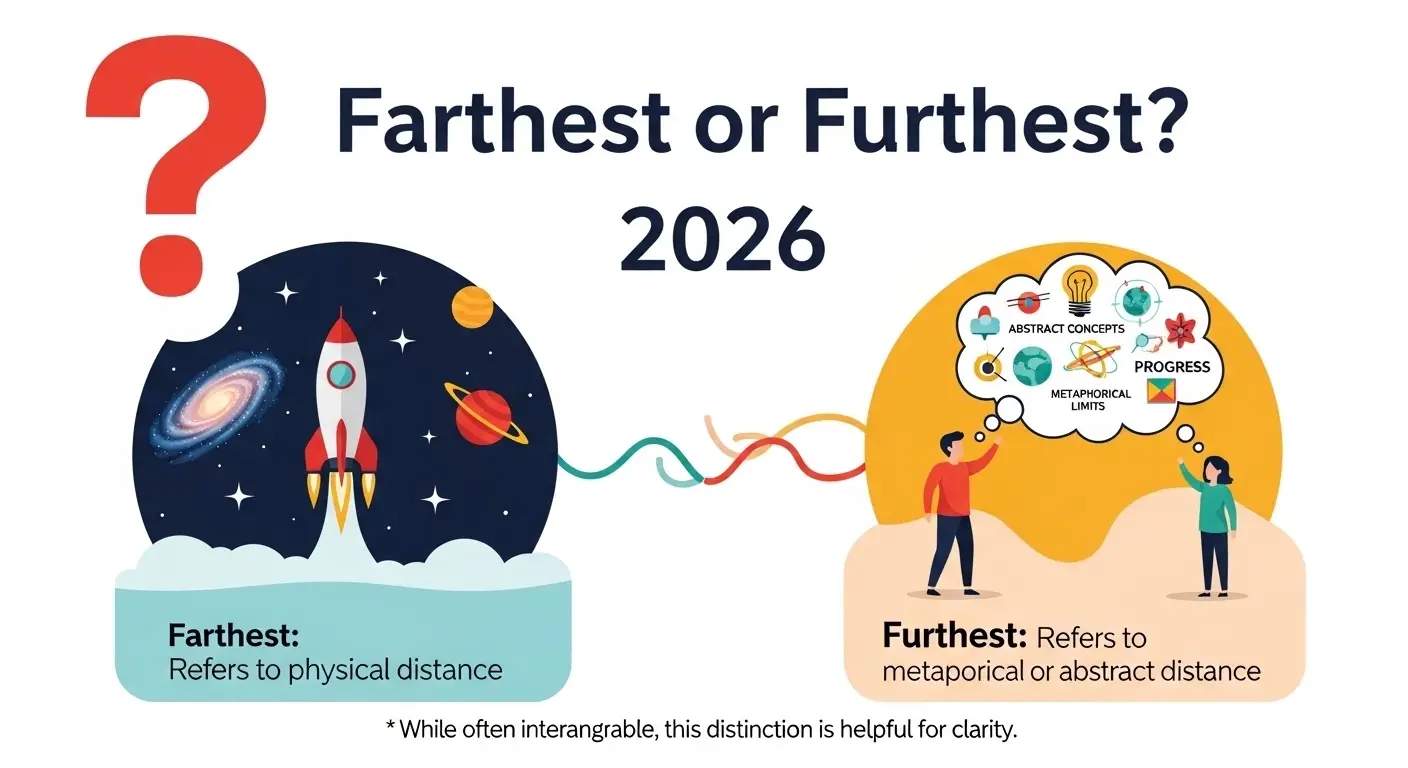
Both words are superlative forms of far, but they are used slightly differently.
- Farthest → Used for physical distance
- Furthest → Used for figurative or abstract distance
Examples:
- The school is the farthest building from my house. ✅ (physical distance)
- This idea is the furthest from the truth. ✅ (abstract meaning)
👉 Simple rule:
- Use farthest for miles or kilometers
- Use furthest for ideas, time, or degree
The Origin of Farthest or Furthest
Both “farthest” and “furthest” come from the Old English word “feorr”, which means “far.”
Over time, English developed two forms:
- Farthest → From far
- Furthest → From further
In early English, there was no strict difference. Writers used both words freely. Even famous authors like Shakespeare used them in mixed ways.
Later, grammar experts tried to create a rule:
- “Farther/farthest” for distance
- “Further/furthest” for ideas
But in modern English, the rule is flexible, not strict. Many native speakers use them interchangeably.
British English vs American English Spelling
The difference between “farthest” and “furthest” is not mainly about spelling regions, but usage still varies slightly.
- American English prefers farthest for physical distance
- British English often uses furthest more broadly
Comparison Table:
| Usage Type | American English | British English |
| Physical distance | farthest | farthest/furthest |
| Abstract meaning | furthest | furthest |
| Everyday speech | farthest more common | furthest more common |
Examples:
- US: “That’s the farthest I’ve ever traveled.”
- UK: “That’s the furthest I’ve ever travelled.”
👉 Key point: Both are correct in both regions.
Which Spelling Should You Use?
Choosing between “farthest” and “furthest” depends on your audience.
Use farthest if:
- You are writing for a US audience
- You mean real distance
- You want a clear and simple rule
Use furthest if:
- You are writing for a UK or global audience
- You mean ideas, progress, or degree
- You want a slightly more formal tone
Best advice:
If unsure, use:
- Farthest → distance
- Furthest → everything else
This keeps your writing clear and correct.
Common Mistakes with Farthest or Furthest
Here are mistakes people often make:
❌ This is the farthest idea from reality.
✔ This is the furthest idea from reality.
❌ He ran the furthest distance in the race.
✔ He ran the farthest distance in the race.
👉 Tip: Always ask yourself Is this about distance or meaning?
Farthest or Furthest in Everyday Examples
1. Emails
- “This is the furthest we can go with this plan.”
- “Our office is the farthest from the airport.”
2. News
- “The storm reached the farthest parts of the coast.”
- “This is the furthest step toward peace.”
3. Social Media
- “I walked the farthest today!”
- “This is the furthest I’ve grown mentally.”
4. Formal Writing
- “The research explores the furthest limits of science.”
- “The village lies at the farthest edge of the region.”
Farthest or Furthest – Google Trends & Usage Data
Search data shows that both keywords are popular worldwide, but usage differs:
- United States → “farthest” is searched more
- United Kingdom → “furthest” is more common
- Global English users → both are used equally
Context trends:
- Travel, maps → farthest
- Business, ideas, progress → furthest
👉 This proves that meaning matters more than spelling location.
Comparison Table: Farthest vs Furthest
| Feature | Farthest | Furthest |
| Meaning | Physical distance | Abstract distance |
| Usage | Miles, space, location | Ideas, degree, progress |
| Popular in | USA | UK & global |
| Formality | Neutral | Slightly formal |
| Example | Farthest city | Furthest point in theory |
FAQs:
1. Are “farthest” and “furthest” the same?
They are similar, but not exactly the same. One is for distance, the other for ideas.
2. Can I use them interchangeably?
Yes, but it’s better to follow the distance vs abstract rule.
3. Which is more correct?
Both are correct. It depends on context.
4. Is “furthest” more formal?
Yes, it can sound slightly more formal.
5. Do Americans use “furthest”?
Yes, but less often than “farthest.”
6. Do British people use “farthest”?
Yes, both words are used in the UK.
7. What about “farther” and “further”?
They are the comparative forms (not superlative).
8. Which should I use in exams?
Follow the rule:
- Distance → farthest
- Ideas → furthest
Conclusion:
The confusion between “farthest” and “furthest” is common, but the solution is simple once you understand the core rule. Both words come from the same origin and are correct in modern English. The difference is mainly about how they are used, not how they are spelled.
Use farthest when talking about physical distance like miles, roads, or locations. Use furthest when talking about ideas, progress, or degree. This small distinction makes your writing clearer and more professional.
It’s also helpful to think about your audience. American readers may expect “farthest” more often, while British and global audiences may prefer “furthest.” Still, both words are widely accepted everywhere.
The best approach is consistency. Pick the right word based on meaning, and stick to it. Over time, it will become natural.
Now, you no longer need to hesitate. You can choose the correct word with confidence every time.

I hold a degree in English Literature and Linguistics and have worked extensively on educational blogs, comparison websites, and digital learning platforms. My writing focuses on simplifying complex language rules, highlighting British vs American English differences, and providing practical examples for everyday usage.