Have you ever paused mid-sentence wondering whether to write sherbet or sherbert? You’re not alone. This small spelling difference causes big confusion for writers, students, food bloggers, and even professional editors. People often hear the word spoken aloud and assume the spelling must include an extra “r.” Others see both versions online and wonder which one is correct or if both are acceptable.
Searches for “sherbet or sherbert” usually come from one simple need: certainty. Is one spelling wrong? Is it a British vs American thing? Does it depend on context, like ice cream versus a powdered drink? The confusion grows because pronunciation doesn’t always match spelling, and dictionaries sometimes list notes that seem contradictory at first glance.
This article clears that confusion once and for all. You’ll get a quick answer, a clear history of the word, and a side-by-side comparison of British and American usage. You’ll also learn which spelling you should use based on your audience, the most common mistakes to avoid, and how the word appears in everyday writing from emails to news articles.
By the end, you’ll know exactly when to use sherbet and why sherbert keeps showing up, even though it causes debate.
Sherbet or Sherbert – Quick Answer
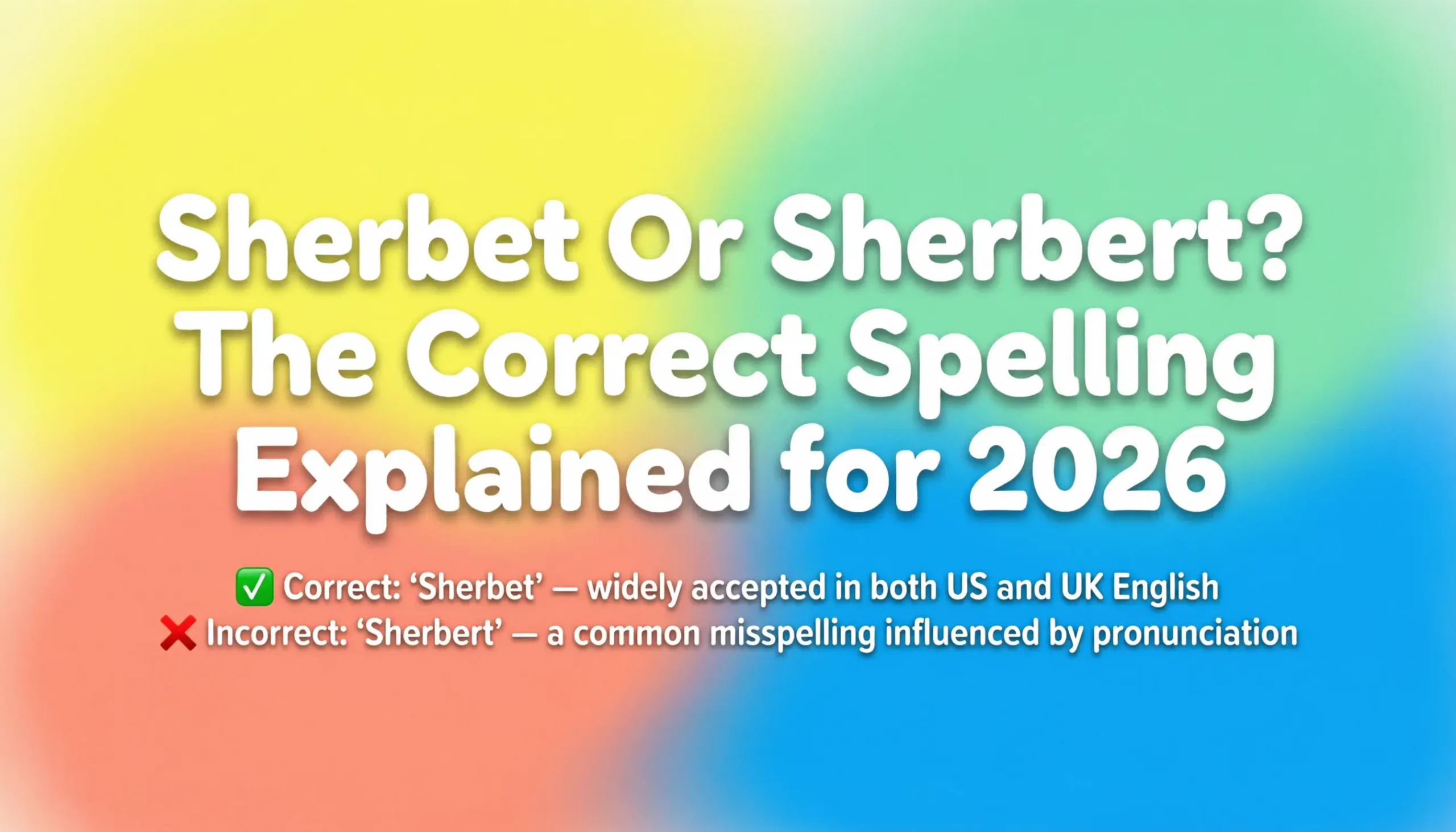
Sherbet is the correct and standard spelling in both British English and American English.
Sherbert is a common misspelling, created by pronunciation habits, not spelling rules.
Examples:
- ✅ I ordered lemon sherbet after dinner.
- ❌ I ordered lemon sherbert after dinner.
- ✅ The recipe includes orange sherbet.
- ❌ The recipe includes orange sherbert.
In short: use “sherbet” in all formal and professional writing.
The Origin of Sherbet or Sherbert
The word sherbet has a long and international history. It comes from the Turkish word “şerbet,” meaning a sweet drink. That word itself traces back to Arabic “shariba,” meaning to drink.
Originally, sherbet referred to a sweet, chilled beverage, not a frozen dessert. As the word traveled through Europe and into English, its spelling stayed close to the original form—without an extra “r.”
So where did “sherbert” come from?
The extra “r” appeared through mispronunciation. In some English accents, people naturally insert an extra “r” sound when speaking quickly. Over time, that spoken habit leaked into writing. However, this spelling was never accepted as standard.
That’s why dictionaries may mention “sherbert” only as a variant pronunciation, not a correct spelling.
British English vs American English Spelling
Unlike many spelling debates, this one is not about UK vs US differences.
Key Rule
Both British and American English agree:
- ✅ Sherbet = correct
- ❌ Sherbert = incorrect
Comparison Table
| English Variety | Correct Spelling | Incorrect Spelling |
| British English | sherbet | sherbert |
| American English | sherbet | sherbert |
| Australian English | sherbet | sherbert |
| Canadian English | sherbet | sherbert |
Important note:
In the US, sherbet often refers to a frozen dessert, while in the UK it may also refer to sweet powder candy. The meaning may change but the spelling does not.
Which Spelling Should You Use?
Your choice is simple once you know your audience.
Use sherbet if:
- You are writing for a US audience
- You are writing for a UK or Commonwealth audience
- You are publishing blogs, articles, recipes, or academic content
- You want SEO-friendly and professional writing
Never use sherbert if:
- You are writing formally
- You care about spelling accuracy
- You want to avoid credibility loss
Professional rule:
If your content will be read globally, always choose “sherbet.”
Common Mistakes with Sherbet or Sherbert
Here are the most frequent errors writers make:
- Adding an extra “r” because of pronunciation
❌ sherbert
✅ sherbet - Assuming it’s a US vs UK difference
❌ US uses sherbert
✅ Both use sherbet - Using “sherbert” in food blogs
❌ Mango sherbert recipe
✅ Mango sherbet recipe - Mixing spellings in the same article
❌ sherbet in one paragraph, sherbert in another
✅ sherbet everywhere - Trusting social media spelling
Social posts often contain errors. Dictionaries do not.
Sherbet or Sherbert in Everyday Examples
Emails
- ✅ “We’ll be serving raspberry sherbet at the event.”
- ❌ “We’ll be serving raspberry sherbert at the event.”
News Writing
- ✅ “The café introduced a new citrus sherbet dessert.”
- ❌ “The café introduced a new citrus sherbert dessert.”
Social Media
- ✅ “This lemon sherbet is perfect for summer.”
- ❌ “This lemon sherbert is perfect for summer.”
Formal Writing
- ✅ “Sherbet is traditionally lighter than ice cream.”
- ❌ “Sherbert is traditionally lighter than ice cream.”
Sherbet or Sherbert – Google Trends & Usage Data
Search data shows that “sherbet” is far more popular worldwide.
Key Trends
- Sherbet dominates searches in:
- United States
- United Kingdom
- Australia
- Canada
- United States
- Sherbert appears mainly in:
- Informal searches
- Voice-based queries
- Misspelled food-related content
- Informal searches
Why “Sherbert” Still Gets Searches
- Spoken pronunciation confusion
- Habit passed down culturally
- Autocorrect errors
- Casual writing online
SEO insight:
Target “sherbet” as the main keyword, but mention “sherbert” as a common mistake to capture user intent.
Comparison Table: Sherbet vs Sherbert
| Feature | Sherbet | Sherbert |
| Correct spelling | ✅ Yes | ❌ No |
| Dictionary accepted | ✅ Yes | ❌ No |
| British English | ✅ Yes | ❌ No |
| American English | ✅ Yes | ❌ No |
| Formal writing | ✅ Yes | ❌ No |
| Common mistake | ❌ No | ✅ Yes |
FAQs:
1. Is “sherbert” ever correct?
No. It is always considered a misspelling.
2. Why do people pronounce sherbet with an extra “r”?
Accent patterns cause the added sound, but spelling does not change.
3. Do dictionaries accept sherbert?
Most list it only as a common error, not a standard spelling.
4. Is sherbet British or American?
The word is used in both, with different meanings but the same spelling.
5. Is sherbet the same as sorbet?
No. Sorbet contains no dairy. Sherbet usually contains some dairy.
6. Can I use sherbert in casual writing?
It’s still incorrect, even in casual contexts.
7. Which spelling is better for SEO?
Sherbet. Always use sherbet as the primary keyword.
8. Why does Google show results for sherbert?
Because many people misspell it when searching.
Conclusion:
The confusion between sherbet or sherbert comes from how the word sounds, not how it should be written. While many people pronounce it with an extra “r,” the correct spelling has always been “sherbet.” This is true in British English, American English, and all major forms of global English.
Understanding the origin of the word helps explain why the spelling never included that extra letter. The mistake spread through speech, habit, and informal writing but dictionaries, editors, and style guides remain consistent. If you want your writing to look polished and trustworthy, sherbet is the only safe choice.
The rule is simple:
If you’re writing it down, write “sherbet.”
Once you remember that, you’ll never hesitate again.

I hold a degree in English Literature and Linguistics and have worked extensively on educational blogs, comparison websites, and digital learning platforms. My writing focuses on simplifying complex language rules, highlighting British vs American English differences, and providing practical examples for everyday usage.