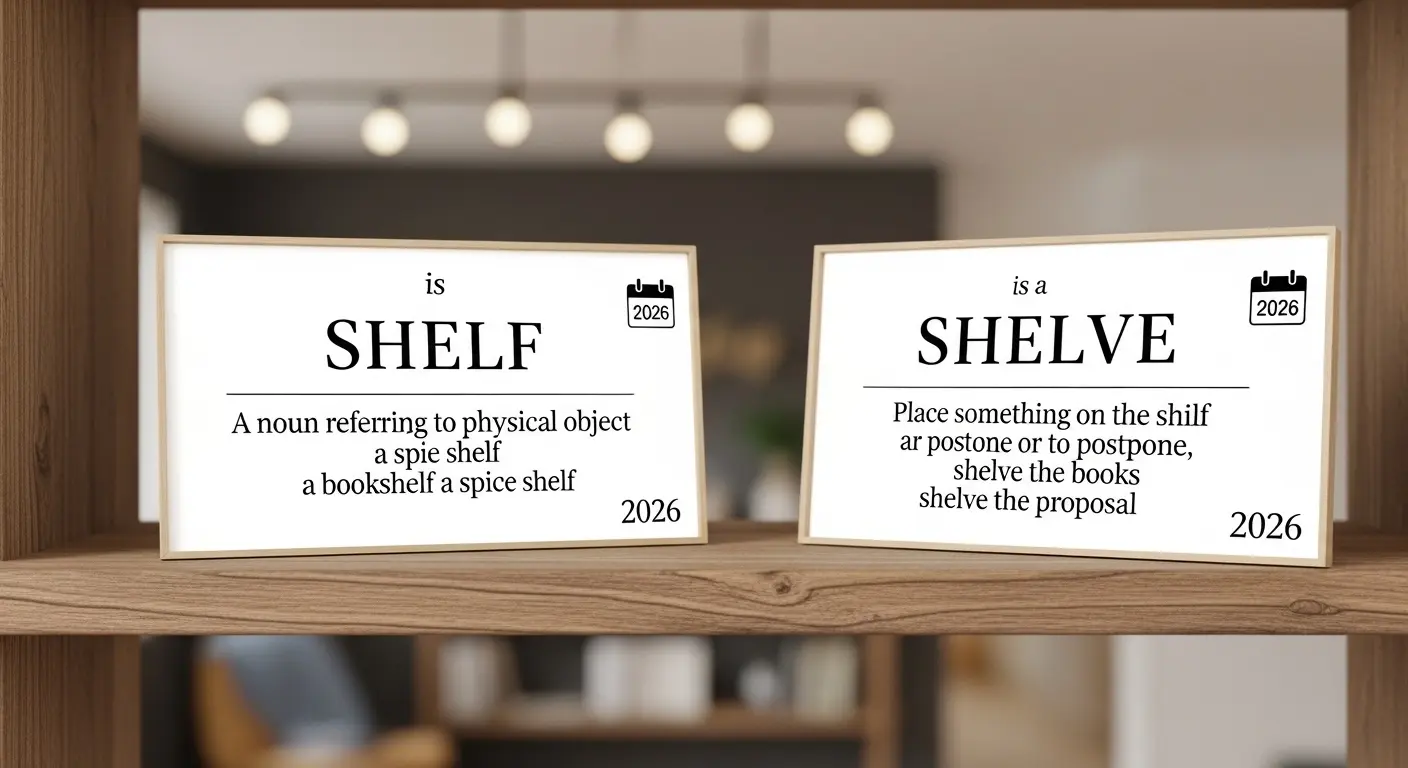
Many people get confused between “shelf” and “shelve.” At first glance, they look almost the same. The only difference is one extra letter “e.” But their meanings are very different. This small spelling change can lead to big mistakes in writing.
People often search for “shelf or shelve” because they are unsure which word to use in a sentence. Is “shelve” just a longer version of “shelf”? Are they both nouns? Can they be used in the same way? These are common questions, especially for learners of English and even native speakers.
The confusion also grows because both words relate to storage or putting things away. However, one is a noun, and the other is a verb. Knowing this simple difference can solve most problems.
In this guide, you will learn the exact meaning of each word, their origins, spelling differences, and how to use them correctly in real-life situations. By the end, you will never mix up “shelf” and “shelve” again.
Shelf or Shelve – Quick Answer
Shelf is a noun. It means a flat surface used to hold items.
Shelve is a verb. It means to put something on a shelf or delay it.
Examples:
- I placed the books on the shelf. ✅
- She will shelve the project for now. ✅
- I placed the books on the shelve. ❌
- This is a wooden shelve. ❌
👉 Quick rule:
- Use shelf for things
- Use shelve for actions
The Origin of Shelf or Shelve
The word “shelf” comes from Old English “scylfe,” meaning a ledge or flat surface. It was used to describe natural rock ledges before it became common for furniture.
Over time, people began using shelves in homes to store items. The word kept its meaning as a physical object.
The word “shelve” came later. It is formed by adding “-ve” to “shelf.” This change turned the noun into a verb. In English, this is a common pattern (like belief → believe).
At first, “shelve” meant simply “to place on a shelf.” Later, it gained a second meaning: to delay or cancel something.
Why the confusion exists:
- Both words look almost identical
- Both relate to storage or putting things away
- One small spelling change changes the word type
British English vs American English Spelling
Good news: There is no spelling difference between British and American English for these words.
Both regions use:
- Shelf (noun)
- Shelve (verb)
Comparison Table
| Usage Type | British English | American English | Example |
| Noun | Shelf | Shelf | The book is on the shelf |
| Verb | Shelve | Shelve | They shelved the plan |
👉 Unlike words like “colour/color,” these remain the same worldwide.
Which Spelling Should You Use?
The choice is simple. It depends on how you use the word, not where you live.
Use “Shelf” when:
- You talk about furniture
- You refer to a physical object
Example:
- The glass is on the kitchen shelf
Use “Shelve” when:
- You describe an action
- You mean to delay or postpone
Example:
- The company decided to shelve the idea
Audience-based advice:
- USA → Use both normally (same rules)
- UK & Commonwealth → Same usage
- Global writing → Follow grammar (noun vs verb)
👉 Tip: If you can replace it with “put away” or “delay,” use shelve.
Common Mistakes with Shelf or Shelve
Here are the most frequent errors people make:
1. Using “shelve” as a noun
❌ I bought a new wooden shelve
✅ I bought a new wooden shelf
2. Using “shelf” as a verb
❌ We will shelf the idea
✅ We will shelve the idea
3. Confusing plural forms
- Correct plural of shelf → shelves
- Not “shelfs” ❌
4. Mixing meanings
❌ The project is on the shelf (if you mean delayed)
✅ The project is shelved
5. Spelling errors
- “Shelve” vs “shelfs” confusion is common
👉 Quick fix:
- Object = shelf
- Action = shelve
Shelf or Shelve in Everyday Examples
Emails
- Please place the files on the shelf
- We may shelve this proposal for now
News
- The bill was shelved after debate
- Books filled every shelf in the library
Social Media
- “Time to clean my shelf!”
- “I had to shelve my travel plans 😢”
Formal Writing
- The documents were stored on a wooden shelf
- The board decided to shelve the project temporarily
👉 Notice how “shelve” often means delay, not just physical action.
Shelf or Shelve – Google Trends & Usage Data
Search data shows that “shelf” is used far more often than “shelve.” This is because “shelf” is common in daily life (furniture, storage, books).
Usage insights:
- “Shelf” → Popular worldwide (home, office, retail)
- “Shelve” → Used more in business and news contexts
By region:
- USA & UK → High use of both
- Asia & ESL regions → More confusion in searches
- Business writing → “Shelve” used often (project delays)
👉 Trend takeaway:
People search “shelf or shelve” mainly to understand grammar, not spelling differences.
Comparison Table: Shelf vs Shelve
| Feature | Shelf | Shelve |
| Word Type | Noun | Verb |
| Meaning | Storage surface | To place or delay |
| Example | Book on the shelf | Shelve the plan |
| Plural | Shelves | N/A |
| Common Use | Home, furniture | Business, decisions |
FAQs:
1. Is “shelve” just a longer form of “shelf”?
No. “Shelve” is a verb, while “shelf” is a noun.
2. Can I use “shelf” as a verb?
No. That is incorrect. Use “shelve” for actions.
3. What is the plural of “shelf”?
The plural is shelves, not “shelfs.”
4. Does “shelve” always mean putting something away?
No. It can also mean delaying or canceling something.
5. Are there spelling differences in UK and US English?
No. Both use the same spellings.
6. Why do people confuse these words?
Because they look similar and are related in meaning.
7. Is “shelved” correct?
Yes. It is the past tense of “shelve.”
8. Can “shelve” be used in formal writing?
Yes. It is common in business and formal contexts.
9. Which word is more common?
“Shelf” is more common in everyday use.
Conclusion:
Understanding the difference between shelf and shelve is simple once you know the basic rule. A shelf is a thing you can see and touch. It holds items like books, dishes, or decorations. On the other hand, shelve is an action. It means putting something on a shelf or delaying it for later.
This confusion often happens because both words are closely related and look almost the same. But remembering one key idea can help: noun vs verb. If you are talking about an object, use “shelf.” If you are describing an action, use “shelve.”
There are no differences between British and American English here, which makes things easier. The main focus should be on correct grammar and context.
In everyday writing emails, social media, or professional documents using the right word improves clarity and credibility. Small mistakes can change meaning, especially when “shelve” is used to mean delay.
Keep practicing with real examples, and soon this confusion will disappear. With this guide, you now have a clear and confident understanding of when to use “shelf” and “shelve.”

I hold a degree in English Literature and Linguistics and have worked extensively on educational blogs, comparison websites, and digital learning platforms. My writing focuses on simplifying complex language rules, highlighting British vs American English differences, and providing practical examples for everyday usage.