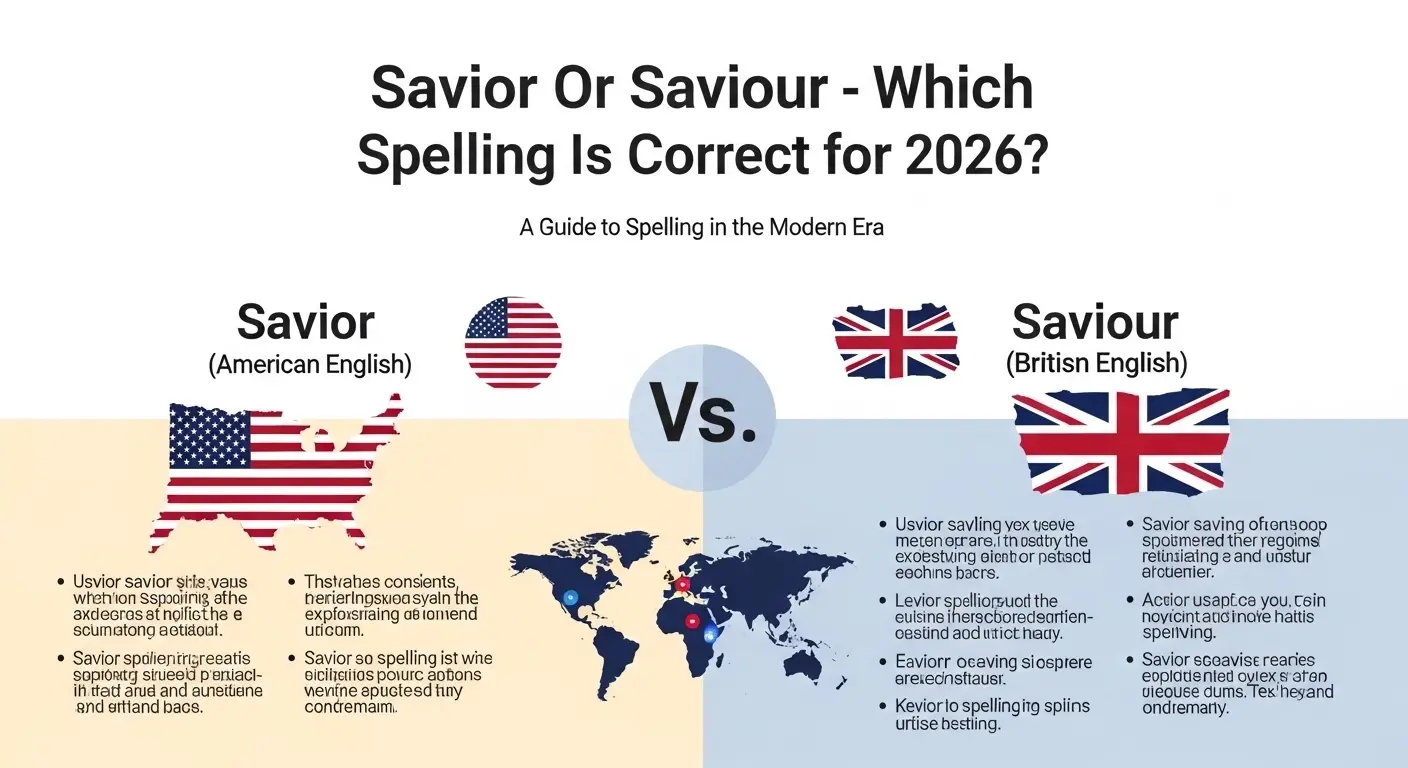
When you’re unsure whether to write “savior” or “saviour”, you’re not alone. Many English writers and learners face this spelling dilemma. The confusion mainly arises because English has different conventions in American and British spellings.
While both forms mean the same thing, a person who saves or rescues choosing the right one depends on your audience.
People search for “savior or saviour” to make their writing accurate, especially in formal contexts, religious texts, or professional content. Using the wrong form can make your writing look less credible or even awkward.
This guide clarifies the difference, shows which spelling fits your audience, highlights common mistakes, and provides everyday examples. Whether you’re drafting an email, writing a story, or preparing content for the web, this article ensures you use the correct form with confidence.
Savior or Saviour – Quick Answer
Quick Answer:
- Savior → American English spelling
- Saviour → British English spelling
Example Sentences:
- American English: “He became a savior for the lost villagers.”
- British English: “She was hailed as the saviour of the team.”
Both words are correct. The only difference is regional spelling.
The Origin of Savior / Saviour
The words come from the Latin “salvator”, meaning “one who saves.” Over time, Middle English adopted the term as “saviour”, following British spelling traditions. American English simplified many words ending with -our to -or during the 18th and 19th centuries.
Thus, “saviour” remained standard in the UK and other Commonwealth countries, while the US switched to “savior” for simplicity. The meaning has always stayed the same—someone who rescues, delivers, or protects.
British English vs American English Spelling
The main difference is the -our vs -or pattern. Words like colour/color, honour/honor, and favour/favor follow the same rule.
| Word | British English | American English |
| Savior | Saviour | Savior |
| Color | Colour | Color |
| Honor | Honour | Honor |
| Favor | Favour | Favor |
Rule:
- Use -our for British English.
- Use -or for American English.
Which Spelling Should You Use?
Your audience decides which spelling is correct:
- US audience: Use savior.
- UK & Commonwealth audience: Use saviour.
- Global content: Check your platform; if targeting an international audience, choose the version most common in your industry.
Tip: Consistency is key. Never mix spellings in the same document.
Common Mistakes with Savior / Saviour
Many writers make these errors:
- Mixing spellings: Writing “He is a savior and saviour” in the same text.
Correction: Stick to one version. - Confusing pronunciation with spelling: Both words sound the same, so don’t guess based on sound.
- Wrong regional context: Using savior in UK newspapers or academic writing might look odd.
Savior / Saviour in Everyday Examples
Emails:
- “Thank you for being my savior during the project crisis.” (US)
- “She was the team’s saviour in the final match.” (UK)
News Headlines:
- “Local firefighter hailed as savior after rescue” (US)
- “Doctor named saviour for curing rare disease” (UK)
Social Media:
- “He’s my gaming savior! #LifeSaver”
- “Our saviour arrived just in time. 🙏”
Formal Writing:
- US: “The savior of the company avoided bankruptcy.”
- UK: “The saviour of the community received an award.”
Savior – Google Trends & Usage Data
Search trends show:
- US: “savior” dominates searches and usage.
- UK: “saviour” is preferred.
- Global: English learners often search “savior or saviour” to confirm proper usage.
Google Trends indicates interest peaks around religious holidays, rescue stories, or popular media using hero narratives.
Comparison Table: Savior vs Saviour
| Aspect | Savior | Saviour |
| English Variant | American English | British English |
| Meaning | One who saves/rescues | One who saves/rescues |
| Common Regions | US, Americas | UK, Australia, Canada |
| Example | “He is our savior.” | “She is our saviour.” |
FAQs:
1. Are savior and saviour the same word?
Yes, they mean the same; only the spelling differs by region.
2. Which is correct in the US?
Use savior.
3. Which is correct in the UK?
Use saviour.
4. Can I use either spelling in global writing?
Yes, but choose one consistently based on audience.
5. Is saviour outdated in American English?
Yes, American English favors savior for modern usage.
6. How do I pronounce savior/saviour?
Both are pronounced /ˈseɪvjər/.
7. Does spelling affect meaning?
No, meaning remains identical.
8. Is savior commonly used in religion?
Yes, both spellings are often used in religious contexts.
9. Can mixing spellings cause errors?
Yes, it looks unprofessional and should be avoided.
Conclusion:
Knowing whether to use savior or saviour is simple once you remember the regional rule: -or for American English and -our for British English. Both words mean the same thing a person who rescues or protects but using the correct form ensures your writing is professional, credible, and clear.
Always consider your audience: US readers expect savior, while UK and Commonwealth readers prefer saviour. In emails, social media posts, formal writing, or news articles, consistency matters more than the choice itself. Using one spelling throughout your content avoids confusion and enhances readability.
Remember: if your audience is global, research your platform norms, but avoid switching between spellings mid-text. With this guide, you can confidently write savior or saviour, knowing your content will resonate with your readers.

I am an Emily Carter Brooks U.S.A based linguistics writer known for my clear, reader-friendly explanations of English grammar and vocabulary differences. I have contributed to multiple online language resources and specializes in spelling variations, pronunciation confusion, and British vs American English comparisons. I believes that learning English should be practical, engaging, and stress-free.