Many students, teachers, and curious readers search for “mitosis or meiosis” because the two terms sound similar but describe very different biological processes. At first glance, both involve cell division, both are taught in school biology, and both appear in exams, textbooks, and science articles. That’s exactly where the confusion begins.
People often mix them up when revising for tests, writing assignments, or even explaining basic biology concepts online. Some assume mitosis and meiosis are just different spellings of the same idea.
This article solves that confusion clearly and simply. You’ll get a quick answer if you’re in a hurry, followed by a deeper explanation if you want full understanding. We’ll cover the origin of the terms, spelling rules in British and American English, common mistakes, real-life usage examples, and even how often people search for “mitosis or meiosis” online.
By the end, you’ll know exactly what each term means, how they differ, and which one to use with confidence in exams, writing, and everyday explanations.
Mitosis or Meiosis – Quick Answer
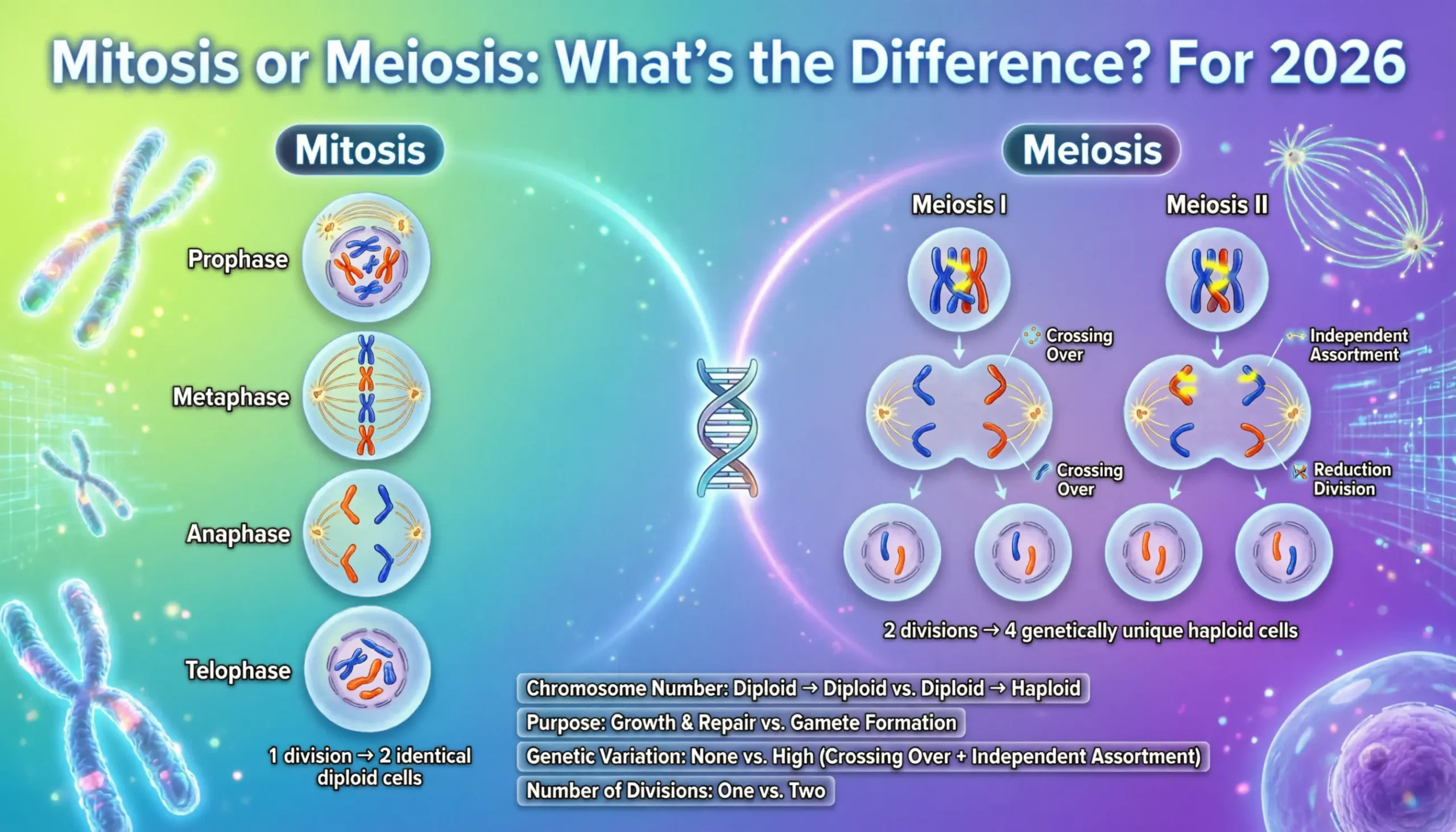
Mitosis is cell division for growth, repair, and maintenance.
Meiosis is cell division for reproduction, producing sperm and eggs.
Simple examples:
- Skin cells dividing to heal a cut → mitosis
- Formation of sperm or egg cells → meiosis
In short:
Mitosis = growth and repair
Meiosis = reproduction and genetic diversity
The Origin of Mitosis or Meiosis
Both words come from Greek, which explains why they look and sound similar.
- Mitosis comes from the Greek word mitos, meaning “thread”. It refers to the thread-like appearance of chromosomes during cell division.
- Meiosis comes from the Greek word meioun, meaning “to lessen” or “to reduce”. This reflects how meiosis reduces chromosome numbers by half.
There are no spelling variations caused by history or regional language changes. Unlike many English words, mitosis and meiosis have remained scientifically standard across countries.
The confusion does not come from spelling. It comes from conceptual similarity both are types of cell division, but with different purposes and outcomes.
British English vs American English Spelling
Here’s an important point:
👉 There is NO spelling difference between British and American English for mitosis or meiosis.
Scientific terms usually stay the same worldwide to avoid misunderstanding in research and education.
Comparison Table
| Term | British English | American English | Meaning |
| Mitosis | Mitosis | Mitosis | Growth and repair |
| Meiosis | Meiosis | Meiosis | Sexual reproduction |
Unlike words such as colour/color or organise/organize, these biology terms are identical everywhere.
Which Spelling Should You Use?
Because the spelling never changes, the real question is:
Which process should you use?
- UK & Commonwealth (UK, Pakistan, Australia, India)
Use mitosis or meiosis exactly as defined in biology. - United States
Same spelling, same meaning. - Global or academic audience
Use the standard scientific definitions. No localisation needed.
Focus on correct usage, not spelling choice.
Common Mistakes with Mitosis or Meiosis
Here are frequent errors people make:
❌ Mistake 1: Using them as interchangeable words
✔️ Correction: They are related but not the same process.
❌ Mistake 2: Saying meiosis happens in all cells
✔️ Correction: Meiosis only happens in reproductive cells.
❌ Mistake 3: Thinking mitosis creates genetic diversity
✔️ Correction: Genetic diversity comes from meiosis, not mitosis.
❌ Mistake 4: Writing “mitoses” or “meioses” incorrectly
✔️ Correction: Plurals exist but are rarely needed outside academic writing.
Mitosis or Meiosis in Everyday Examples
Emails
“The lesson today covered mitosis, focusing on cell growth.”
News Articles
“Scientists studied errors in meiosis that can lead to genetic disorders.”
Social Media
“Finally understand the difference between mitosis or meiosis 😅 biology makes sense now!”
Formal Writing
“Meiosis plays a critical role in maintaining chromosome stability across generations.”
Mitosis or Meiosis – Google Trends & Usage Data
Search data shows that “mitosis or meiosis” spikes during:
- Exam seasons
- School and university biology courses
- Online learning trends
Popular by region:
- High search volume: UK, USA, India, Pakistan
- Context: Education, exams, biology basics
People usually search this keyword to:
- Compare differences quickly
- Avoid exam mistakes
- Get simple explanations
This confirms strong informational intent, not spelling confusion.
Comparison Table: Mitosis vs Meiosis
| Feature | Mitosis | Meiosis |
| Purpose | Growth and repair | Reproduction |
| Occurs in | Body cells | Sex cells |
| Number of divisions | One | Two |
| Daughter cells | Two identical cells | Four different cells |
| Chromosome number | Same as parent cell | Half of parent cell |
FAQs:
1. Is mitosis the same as meiosis?
No. They are different types of cell division with different purposes.
2. Which is for growth, mitosis or meiosis?
Mitosis is for growth and repair.
3. Which creates genetic variation?
Meiosis creates genetic diversity.
4. Do mitosis and meiosis have different spellings in UK and US English?
No. The spelling is the same worldwide.
5. Why do students confuse mitosis or meiosis?
Because both involve cell division and are taught together.
6. Can meiosis happen in skin cells?
No. Only reproductive cells undergo meiosis.
7. Is mitosis used in asexual reproduction?
Yes, in organisms that reproduce asexually.
8. Are these terms used outside biology?
Rarely. They are mostly scientific terms.
Conclusion:
Understanding mitosis or meiosis is less about spelling and more about purpose. Both terms are essential in biology, but they describe two very different processes. Mitosis helps organisms grow, heal, and maintain their bodies. Meiosis, on the other hand, enables sexual reproduction and introduces genetic variation, which is vital for evolution.
There is no British or American spelling difference to worry about. The terms remain consistent across textbooks, exams, and scientific research worldwide. This makes your job simpler: focus on using the right word in the right context.
If you’re studying for exams, remember the core idea mitosis equals growth, meiosis equals reproduction. If you’re writing professionally or academically, clarity matters more than complexity. Use simple explanations and clear comparisons to avoid confusion.

I hold a degree in English Literature and Linguistics and have worked extensively on educational blogs, comparison websites, and digital learning platforms. My writing focuses on simplifying complex language rules, highlighting British vs American English differences, and providing practical examples for everyday usage.