People often search for horizontal or vertical because these two words look simple but cause real confusion in daily life. You see them everywhere on phone screens, documents, charts, videos, buildings, and even job descriptions. Yet many people still pause and ask: Which one is horizontal? Which one is vertical?
The confusion usually starts with direction. Is horizontal left to right or up and down? Does vertical mean portrait or landscape? And why do designers, teachers, and engineers care so much about the difference?
This keyword also attracts students, professionals, and content creators who want a quick answer but also need clear examples. A graphic designer may want to choose the correct layout. A student may want to describe a graph correctly. A social media manager may need to pick the right video format.
This article solves that confusion step by step. First, you’ll get a fast and clear definition. Then, you’ll learn the origin of both words, spelling rules, common mistakes, real-life examples, and usage trends. By the end, you’ll know exactly when to use horizontal and when to use vertical without second-guessing.
Horizontal or Vertical – Quick Answer
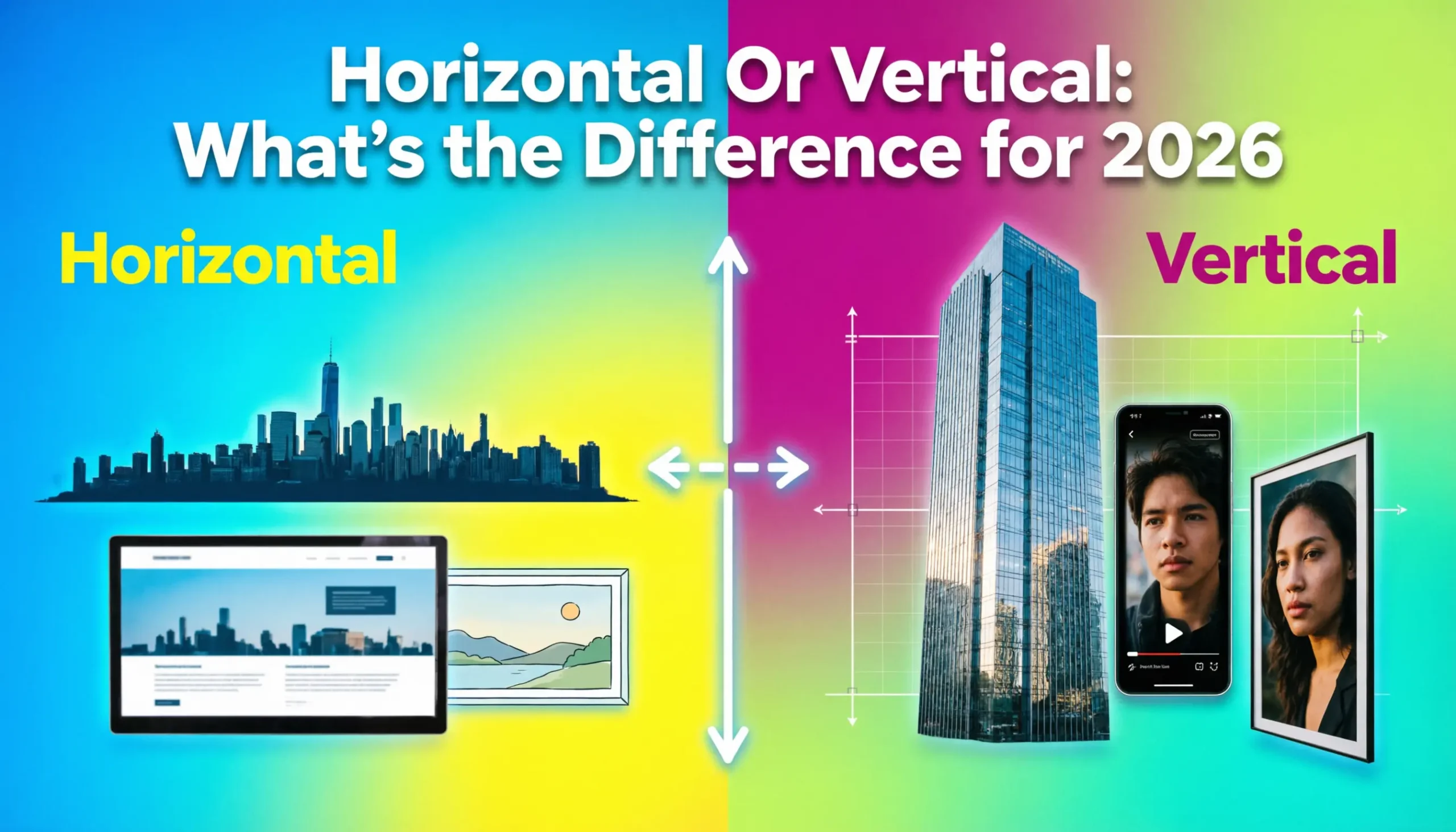
Horizontal means left to right, like the horizon where the sky meets the land.
Vertical means up and down, like a tree growing straight upward.
Simple examples:
- A horizontal line goes from left to right.
- A vertical line goes from top to bottom.
- A horizontal video fits a TV screen.
- A vertical video fits a mobile phone screen.
If it looks wide, it’s horizontal.
If it looks tall, it’s vertical.
The Origin of Horizontal or Vertical
The word horizontal comes from the Greek word horizōn, meaning “bounding” or “separating.” It later referred to the horizon, the flat line you see where the earth meets the sky. Over time, horizontal came to mean anything that runs parallel to the ground.
The word vertical comes from the Latin word verticalis, which is linked to vertex, meaning “highest point.” This explains why vertical describes things that go upward or downward.
There are no spelling variations caused by history. Both words entered English through Latin and French and kept their original spellings. That’s why horizontal and vertical look the same in all modern English varieties.
British English vs American English Spelling
There is no spelling difference between British English and American English for these words.
Both varieties use:
- Horizontal
- Vertical
This makes them easier than words like colour/color or centre/center.
Spelling comparison table
| Term | British English | American English |
| Horizontal | Horizontal | Horizontal |
| Vertical | Vertical | Vertical |
Pronunciation may vary slightly, but spelling stays the same.
Which Spelling Should You Use?
Because the spelling does not change, the choice is not about spelling, but about context.
- UK & Commonwealth: Use the words normally in education, design, and formal writing.
- US audience: Same spelling, same meaning.
- Global audience: These words are universally understood and safe to use.
Your only real decision is which word fits the direction you mean—horizontal or vertical.
Common Mistakes with Horizontal or Vertical
Even simple words can cause mistakes. Here are the most common ones:
1. Mixing up directions
❌ “The phone video is horizontal” (when it’s tall)
✅ “The phone video is vertical”
2. Confusing screen orientation
❌ Calling portrait mode horizontal
✅ Portrait = vertical, Landscape = horizontal
3. Wrong use in charts
❌ “The vertical axis goes left to right”
✅ The horizontal axis goes left to right
4. Overusing both together
❌ “The image is horizontal vertical”
✅ Choose one, not both
Horizontal or Vertical in Everyday Examples
Emails
- “Please send the image in horizontal format.”
- “The table should be vertical for readability.”
News
- “The building features vertical steel beams.”
- “The road markings are horizontal.”
Social Media
- “Instagram Reels prefer vertical videos.”
- “YouTube banners work best in horizontal layout.”
Formal Writing
- “Data is shown using horizontal bar charts.”
- “The diagram includes vertical alignment.”
Horizontal or Vertical – Google Trends & Usage Data
Search interest for horizontal or vertical is high worldwide. People mostly search it in:
- Education (maths, geometry)
- Design (graphics, UX, video)
- Technology (screens, phones, layouts)
Usage by region:
- United States & UK: High searches in design and education
- Asia: High interest in mobile video orientation
- Global: Used equally in technical and everyday language
The keyword often appears in comparison searches, showing that users want clarity, not just definitions.
Horizontal vs Vertical – Comparison Table
| Feature | Horizontal | Vertical |
| Direction | Left to right | Up and down |
| Shape | Wide | Tall |
| Example | Horizon, TV screen | Tree, mobile video |
| Axis in graphs | X-axis | Y-axis |
| Screen mode | Landscape | Portrait |
FAQs:
1. Is horizontal left to right?
Yes. Horizontal always runs left to right.
2. Is vertical up and down?
Yes. Vertical goes from top to bottom.
3. Is portrait vertical or horizontal?
Portrait is vertical.
4. Is landscape horizontal?
Yes. Landscape is horizontal.
5. Which is better for mobile videos?
Vertical works best for mobile screens.
6. Which is better for TV or YouTube?
Horizontal is better for TVs and wide screens.
7. Do horizontal and vertical have spelling differences?
No. Spelling is the same in British and American English.
8. Can something be both horizontal and vertical?
Not at the same time. It must be one direction.
9. Are these words formal or informal?
They are neutral and work in all writing styles.
Conclusion:
The difference between horizontal or vertical is simple once you see it clearly. Horizontal means left to right, like the horizon. Vertical means up and down, like a standing tree. These two words appear simple, yet they play a major role in education, design, technology, and everyday communication.
There is no spelling confusion between British and American English, which makes them easy to use globally. The real challenge is choosing the correct word based on direction and context. Mistakes usually happen when people confuse screen orientation, chart axes, or image layouts.
If you’re writing an email, creating a video, designing a graphic, or explaining data, using the right term improves clarity and professionalism. When something is wide, go with horizontal. When something is tall, choose vertical.
Once you remember the horizon for horizontal and height for vertical, you’ll never mix them up again. Clear language leads to clear understanding and now you have both.

I am an Emily Carter Brooks U.S.A based linguistics writer known for my clear, reader-friendly explanations of English grammar and vocabulary differences. I have contributed to multiple online language resources and specializes in spelling variations, pronunciation confusion, and British vs American English comparisons. I believes that learning English should be practical, engaging, and stress-free.