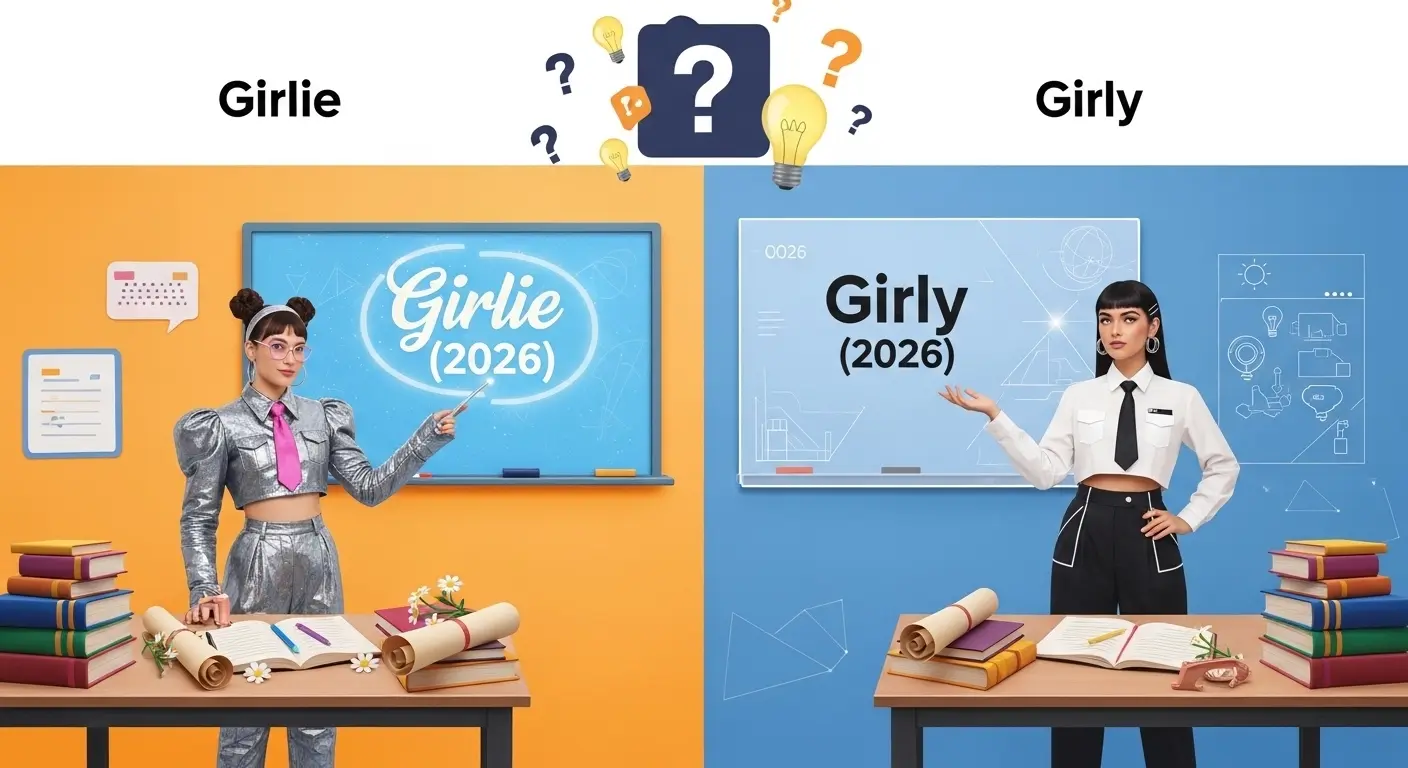
Have you ever wondered whether it’s “girlie” or “girly”? This question pops up a lot in writing, speaking, and even in search engines. People search for “girlie or girly” because they want to use the correct form in emails, text messages, school essays, and social posts.
The confusion comes from hearing both versions in speech and seeing both forms online. At first glance, these two words seem similar, but one is far more common and accepted in modern English.
Understanding the difference helps you write more confidently and avoids simple spelling errors. This article breaks down the meanings, origins, spelling differences, and usage tips for “girlie” and “girly.” You’ll learn when to use each form, how they show up in different kinds of writing, and how Google Trends reflects their popularity.
If you’re a student, writer, or someone who wants to speak and write correctly, this guide clears up the confusion quickly and clearly. Let’s get started!
Girlie or Girly – Quick Answer
Quick Answer:
The more commonly accepted spelling is “girly.” It’s used to describe something that is characteristic of girls, usually in a playful, pretty, or feminine way.
Examples:
- She loves wearing girly dresses and bows.
- That party had a very girly theme with pink balloons.
- “Girlie” is seen occasionally but is less standard.
In short, if you’re choosing one spelling for everyday writing, “girly” is the one most people expect and understand.
The Origin of Girlie or Girly
The words “girly” and “girlie” come from the base word “girl” plus a suffix that turns it into an adjective. This suffix changes depending on style, trend, and sometimes region.
- Root word: girl → meaning a female child or young woman.
- Suffix: -y or -ie → both can make adjectives meaning “like” or “characteristic of.”
Historically, “girlie” appeared in older texts and informal language first. In late 1800s and early 1900s English, adding -ie to nouns to make friendly or diminutive forms (like “doggie,” “selfie,” “bookie”) was common.
Over time, the “-y” ending became the standard form for adjectives formed from nouns (like “manly,” “boyish,” “childish”). So “girly” replaced “girlie” in formal writing and standard dictionaries.
That’s why both exist: one came from friendly informal usage, and the other became the accepted standard.
British English vs American English Spelling
In many cases, British and American English have differences like “colour” vs “color” or “theatre” vs “theater.” But with “girly” and “girlie,” the situation is simpler.
- British English: The preferred form is “girly.”
- American English: The preferred form is also “girly.”
Even though “girlie” shows up occasionally in older British texts or informal speech, both versions mostly agree today that “girly” is the standard spelling.
British vs American Spelling Table
| Spelling | British English | American English | Formal Writing |
| girly | ✔️ Standard | ✔️ Standard | ✔️ Correct |
| girlie | ❌ Informal/old | ❌ Informal/old | ❌ Not recommended |
Key Rule: In both versions of English, “-y” is the recommended adjective ending.
Which Spelling Should You Use?
If You’re in the United States
Use “girly.” It’s the widely accepted form in American English and appears in most dictionaries.
If You’re in the United Kingdom or Commonwealth Countries
Still use “girly.” That’s the modern correct form in British English too.
If You’re Writing for a Global Audience
Go with “girly.” It’s the safest choice for international readers, schools, and professional contexts.
When “Girlie” Might Be Okay
- In creative writing to show informal speech.
- In dialogue to capture a certain tone.
- In older texts or stylistic choices where the author intentionally uses playful spelling.
But in clear, correct English, “girly” is the winner.
Common Mistakes with Girlie or Girly
People often make the same errors when using these words. Here are some mistakes and the corrected versions:
✔️ Incorrect: She bought a very girlie handbag.
✔️ Correct: She bought a very girly handbag.
✔️ Incorrect: He said the movie was too girlie.
✔️ Correct: He said the movie was too girly.
✔️ Incorrect: This is a girlie event.
✔️ Correct: This is a girly event.
Tip: Always prefer “girly” unless you have a creative reason for girlie.
Girlie or Girly in Everyday Examples
Emails
❌: “Please bring a girlie gift to the party.”
✔️: “Please bring a girly gift to the party.”
Social Media
- “Check out these girly outfits! 💖”
- “Such a girly vibe today!”
News Headlines
- “New Study Shows girly Colors Impact Buying Habits.”
- “Fashion Week Highlights the girly Trend Again.”
Formal Writing
- Use girly carefully: not usually in academic papers unless context requires it.
- Better alternatives: feminine, youthful, female-oriented.
Girlie or Girly – Google Trends & Usage Data
When people search for language questions like “girlie or girly,” they often want quick assurance about correct spelling. Tools like Google Trends show that people search for spelling questions when:
- They’re writing something important.
- They see two versions and aren’t sure which is right.
- They want to avoid grammar mistakes.
Search patterns usually show spikes in queries like this when school terms are active, or during fashion and pop culture events.
In general:
- “girly” appears much more frequently in search results.
- “girlie” shows low usage, mostly in phrases like “girlie magazine” (older expression referring to magazines aimed at young women).
Bottom Line: Data supports the idea that “girly” is the dominant, modern, and preferred form.
Spelling Comparison Table
Here’s a quick view of the two forms side by side:
| Feature | girly | girlie |
| Dictionary Standard | ✔️ Yes | ❌ No |
| Use in Modern English | ✔️ Common | ❌ Rare |
| Formal Writing | ✔️ Yes | ❌ No |
| Informal Style Only | ⚠️ Sometimes | ✔️ Sometimes |
| Easy Recognition | ✔️ High | ❌ Low |
FAQs:
1. Is “girlie” a real word?
Yes, it exists but is old and informal. The preferred spelling today is “girly.”
2. Which is correct: “girlie” or “girly”?
Girly is correct in modern writing in most contexts.
3. Can I use “girlie” in creative writing?
Yes, but only for style or voice, not in formal text.
4. Are both words used in British English?
Yes, but “girly” is the standard form in British English too.
5. Does “girly” have a negative meaning?
Not necessarily. It describes something feminine or pretty, though context matters.
6. Is “girly” only for girls?
No. It describes style, color, or vibe, not the person themselves.
7. Should I use “girly” in school essays?
Only if the topic calls for it. If not, choose more formal alternatives.
8. Is there a pronunciation difference?
No. Both are pronounced the same (/ˈɡɜː(r)li/).
9. Why do people still use “girlie”?
Some people like old-fashioned or playful spelling, especially in branding or titles.
Conclusion:
In the battle of “girlie or girly,” the clear winner for most writing is “girly.” It’s the form accepted by dictionaries and style guides across English-speaking countries. “Girlie” exists mainly as an informal or older variant. If you’re writing an email, article, school assignment, or social post, you’re safest with “girly.” When in doubt, check a standard dictionary or think about your audience. Writers aiming for clarity and correctness will choose “girly” 99 times out of 100.
Remember that language changes over time, but spelling rules help keep it clear for everyone. Whether you’re writing about fashion, personality traits, or describing something feminine, “girly” is the modern choice that most readers expect. Use it confidently and avoid the common mistakes that come with mixing the two forms. Clear writing starts with correct spelling and now you know which one to use.

I hold a degree in English Literature and Linguistics and have worked extensively on educational blogs, comparison websites, and digital learning platforms. My writing focuses on simplifying complex language rules, highlighting British vs American English differences, and providing practical examples for everyday usage.