English learners and writers often wonder whether to use favor or favour. The confusion arises because English spelling varies between American and British styles. Choosing the right form is essential for clear communication, professional writing, and even academic work. Understanding the difference can prevent embarrassing mistakes in emails, essays, or social media posts.
Many people search for “favor or favour” because both words sound the same, mean the same thing, and are interchangeable depending on the region.
However, the spelling you choose can indicate whether your writing follows American English (US) or British English (UK and Commonwealth). In this guide, we will provide a quick answer, explain the origin, compare usage, highlight common mistakes, and give real-life examples.
By the end, you’ll know exactly which spelling to use in any context, saving time and improving your writing confidence.
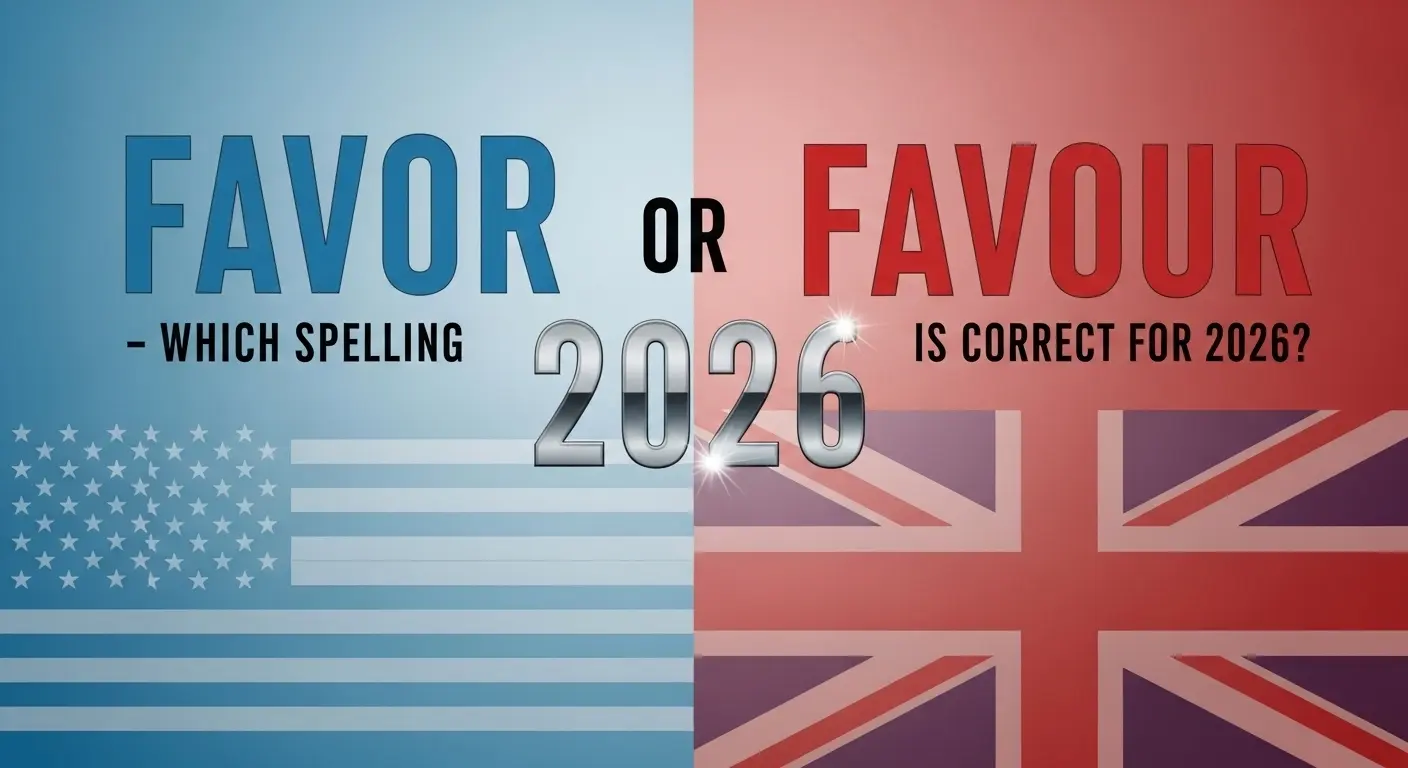
Favor or Favour – Quick Answer
- Favor → American English
- Favour → British English
Example Sentences:
- US: Could you do me a favor and send the report today?
- UK: Could you do me a favour and send the report today?
Both words mean the same thing: a kind action, support, or preferential treatment.
The Origin of Favor/Favour
The word comes from Latin “favorem”, meaning goodwill or support. In Middle English, it appeared as favour, influenced by Old French.
- British English retained the “u,” keeping it closer to the original spelling.
- American English simplified the spelling to favor, following Noah Webster’s reforms in the 19th century, aiming for easier, phonetic spelling.
This history explains why you see two correct forms depending on the region.
British English vs American English Spelling
American and British English often differ in words with -our vs -or endings.
| British English | American English | Example Sentence |
| favour | favor | Can you do me a favour/favor? |
| colour | color | The colour/color of the sky is beautiful. |
| honour | honor | She received the honour/honor award. |
| neighbour | neighbor | My neighbour/neighbor is very friendly. |
Rule: Words ending in -our in UK English usually drop the u in US English.
Which Spelling Should You Use?
- US audience → Use favor.
- UK, Canada, Australia, India → Use favour.
- Global audience → Consider your readers. For international content, both are acceptable, but consistency is key.
Tip: When writing professionally, pick one style and stick to it.
Common Mistakes with Favor/Favour
- Mixing spellings → I need a favor/favour from you (use one form consistently).
- Incorrect verb form → He favours/favors ice cream (correct depending on UK/US).
- Misspelling → faver or favur is wrong.
- Using in plural incorrectly → favors/favours → Always match singular/plural form to style.
Favor/Favour in Everyday Examples
Emails:
- US: Thank you for doing me a favor.
- UK: Thank you for doing me a favour.
News Headlines:
- US: President grants favor to local business.
- UK: Government shows favour to new initiative.
Social Media:
- US: Doing someone a favor never hurts.
- UK: Showing favour to employees boosts morale.
Formal Writing:
- Choose spelling based on your target style guide (APA, MLA, Oxford, etc.).
Favor or Favour – Google Trends & Usage Data
Data from Google Trends shows:
- US searches predominantly use favor.
- UK, Australia, Canada show higher usage of favour.
- Overall, the word is searched often by writers, students, and professionals wanting correct spelling in emails and academic papers.
Comparison Table: Favor vs Favour
| Feature | Favor (US) | Favour (UK) |
| Spelling Style | American | British |
| Common Use | US, global for American English | UK, Australia, Canada, India |
| Examples | Do me a favor | Do me a favour |
| Plural | favors | favours |
| Formal/Professional | Preferred in US style | Preferred in UK style |
FAQs:
- Are favor and favour the same word?
Yes, the meaning is the same; only the spelling differs. - Which is correct in American English?
Favor is correct in the US. - Which is correct in British English?
Favour is correct in the UK and Commonwealth countries. - Can I use both in one document?
No, choose one style and stay consistent. - Is “favors” plural in both forms?
Yes, “favors” (US) and “favours” (UK) are correct. - Does this word change in verbs?
Yes, “he favors/favours” depending on US or UK spelling. - Is it okay to use “favor” globally?
It is acceptable, but UK readers may prefer “favour.” - Why does the US drop the “u”?
Noah Webster simplified spellings to make them more phonetic. - Is there a pronunciation difference?
No, both are pronounced the same: /ˈfeɪvər/.
Conclusion:
Understanding the difference between favor and favour is crucial for accurate and professional writing. While the meaning remains identical, choosing the correct spelling depends on your audience. Use favor for American English and favour for British English or Commonwealth contexts. Be consistent within a document to avoid confusion.
By knowing the origin, the spelling rules, and common mistakes, you can confidently use the word in emails, formal writing, or social media. Remember, clarity matters more than style, but proper spelling reinforces credibility and professionalism. With the comparison tables, examples, and FAQs in this guide, you now have everything needed to decide which form to use in any situation. Whether writing to a US audience or a global one, understanding the nuances of favor vs favour ensures polished, mistake-free communication.

I am an Emily Carter Brooks U.S.A based linguistics writer known for my clear, reader-friendly explanations of English grammar and vocabulary differences. I have contributed to multiple online language resources and specializes in spelling variations, pronunciation confusion, and British vs American English comparisons. I believes that learning English should be practical, engaging, and stress-free.