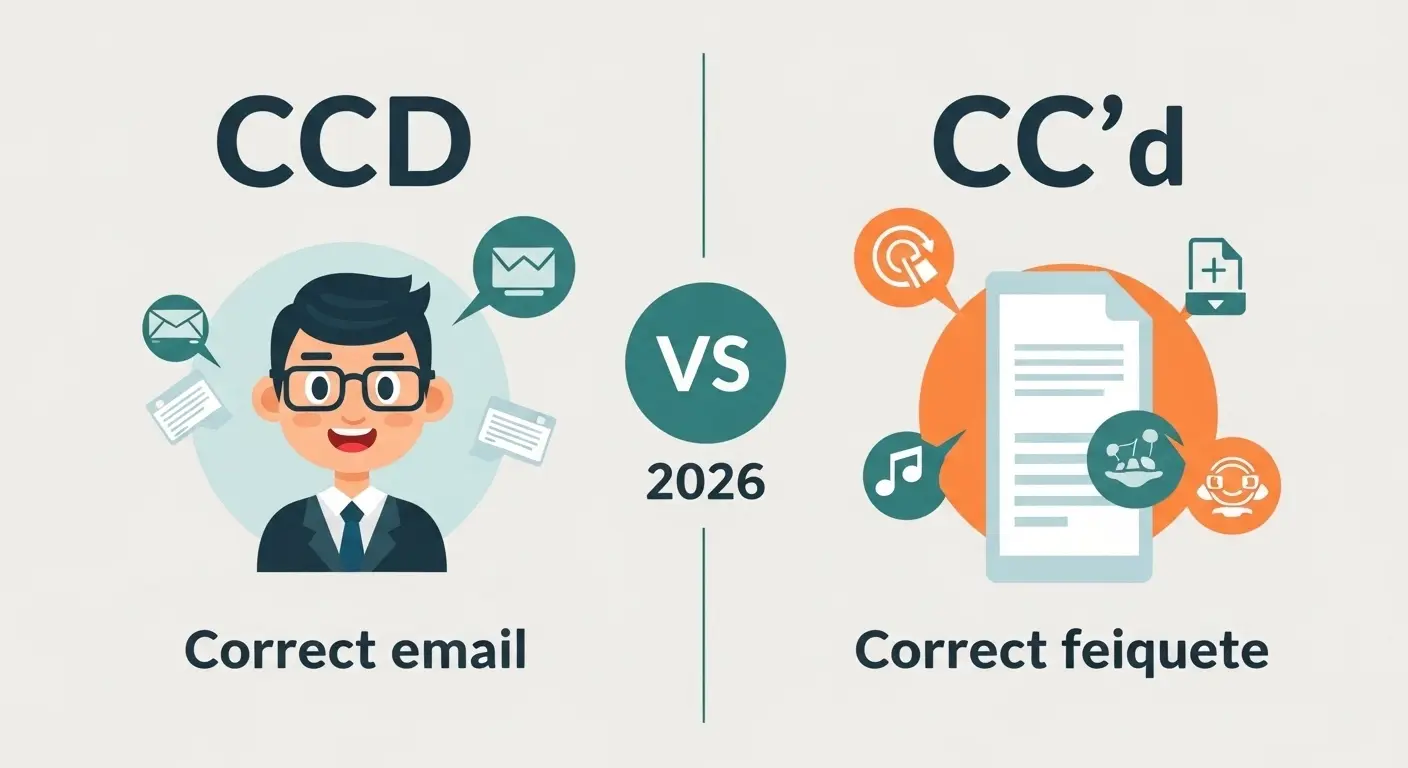
Have you ever paused while writing an email and wondered: should it be ccd or cc’d? You’re not alone. This small detail confuses many people, especially in professional communication. The terms look similar, but one is correct while the other can make your writing look careless.
People search for “ccd or cc’d” because email writing is now part of daily work and study. If you’re sending a formal email, copying someone on a message, or writing instructions, using the right form matters. A small grammar mistake can affect clarity and professionalism.
The confusion usually comes from how abbreviations work in English. Should you add an apostrophe? Should you treat “cc” like a verb? These questions lead to mixed usage online.
In this guide, you’ll get a quick answer, clear rules, real examples, and expert advice. By the end, you’ll know exactly when to use cc’d and why ccd is usually incorrect.
CCD or CC’d – Quick Answer
Correct form: CC’d
Incorrect form: CCD (in most cases)
- CC’d means “carbon copied” and is the correct past tense form.
- CCD is not standard in email writing and is rarely correct.
Examples:
- ✅ I have CC’d the manager on this email.
- ❌ I have CCD the manager on this email.
- ✅ She was CC’d in the message.
- ❌ She was CCD in the message.
👉 Use CC’d when you turn “CC” into a verb.
The Origin of CCD or CC’d
The term CC comes from “carbon copy.” Before email, people used carbon paper to make copies of documents. When someone received a copy, they were “cc’ed.”
Over time, email systems kept this term. The “CC” field lets you send a copy of an email to others.
Now, when people use “CC” as a verb, they need to follow English grammar rules. That’s why CC’d appears with an apostrophe to show the past tense of an abbreviation.
Why not “CCD”?
Because simply adding “D” to an abbreviation without punctuation can look unclear or incorrect. English often uses apostrophes when turning abbreviations into verbs.
British English vs American English Spelling
Interestingly, there is no major difference between British and American English for this term. Both follow the same rule.
| Feature | British English | American English |
| Correct form | CC’d | CC’d |
| Incorrect form | CCD | CCD |
| Usage style | Formal and informal | Formal and informal |
Key Point:
Both styles prefer CC’d because it follows standard grammar for abbreviations.
Which Spelling Should You Use?
If You’re Writing in the US:
Use CC’d in emails and documents. It’s widely accepted and expected.
If You’re in the UK or Commonwealth:
Use CC’d as well. It is the standard form.
For Global Communication:
Always choose CC’d. It is clear, professional, and understood worldwide.
👉 Simple rule:
If you are using “CC” as a verb, write CC’d.
Common Mistakes with CCD or CC’d
Here are common errors people make:
1. Writing “CCD” instead of “CC’d”
- ❌ I CCD him in the email
- ✅ I CC’d him in the email
2. Forgetting the apostrophe
- ❌ I CCed her
- ✅ I CC’d her
3. Using “CC” without context
- ❌ I CC him
- ✅ I will CC him
4. Mixing tenses
- ❌ I have CC him
- ✅ I have CC’d him
5. Overusing the term
Sometimes it’s better to write clearly:
- Instead of: I CC’d John
- You can say: I copied John on the email
CCD or CC’d in Everyday Examples
Emails:
- I’ve CC’d the finance team for review.
- Please see the update. I have CC’d the supervisor.
News / Business Writing:
- The report was shared, and key stakeholders were CC’d.
Social Media:
- I CC’d you in the post check it out!
Formal Writing:
- The client has been CC’d to ensure transparency.
👉 In all cases, CC’d is the correct and natural form.
CCD or CC’d – Google Trends & Usage Data
Search data shows that “cc’d” is far more popular than “ccd” in writing contexts.
Usage Insights:
- CC’d is widely used in:
- Business emails
- Office communication
- Professional writing
- CCD is mostly used in:
- Technical contexts (like electronics, e.g., Charge-Coupled Device)
- Not for email usage
By Region:
- USA: Strong preference for CC’d
- UK: Same preference
- Global: CC’d dominates in professional writing
👉 Conclusion: “CCD” is rarely used for email meaning and may confuse readers.
Comparison Table: CCD vs CC’d
| Feature | CC’d | CCD |
| Meaning | Carbon copied (verb) | Not standard for email |
| Correct usage | ✅ Yes | ❌ No |
| Grammar | Proper apostrophe use | Incorrect form |
| Common in emails | Very common | Rare |
| Professional writing | Recommended | Not recommended |
FAQs:
1. Is “CCD” ever correct?
Yes, but only in technical fields (like imaging devices). Not for email meaning.
2. Why does “CC’d” have an apostrophe?
Because it turns an abbreviation into a past tense verb.
3. Can I write “CCed” instead of “CC’d”?
It’s sometimes seen, but CC’d is more accepted and clearer.
4. What does “CC” stand for?
It stands for “carbon copy.”
5. Is “CC’d” formal or informal?
It works in both formal and informal writing.
6. Can I use “CC” as a verb?
Yes. Example: I will CC you.
7. What is the past tense of CC?
The correct past tense is CC’d.
8. Is “cc’d” (lowercase) acceptable?
Yes in casual writing, but uppercase CC’d is better in formal emails.
Conclusion:
The difference between ccd and cc’d is simple but important. While both may look similar, only one is correct for everyday email use. The correct form is CC’d, which follows proper grammar rules for abbreviations used as verbs. The apostrophe helps make the meaning clear and professional.
Using CCD in email writing is a common mistake. It can confuse readers or make your message look less polished. However, CCD does have meaning in technical fields, so context matters. Still, for emails and communication, it should be avoided.
Both British and American English agree on using CC’d, so you don’t need to worry about regional differences. This makes it easy to follow one consistent rule no matter where you are.
To write better emails, keep it simple: use CC’d when referring to copying someone. This small change can improve clarity and professionalism in your writing.

I hold a degree in English Literature and Linguistics and have worked extensively on educational blogs, comparison websites, and digital learning platforms. My writing focuses on simplifying complex language rules, highlighting British vs American English differences, and providing practical examples for everyday usage.